Get Full Government Meeting Transcripts, Videos, & Alerts Forever!
Get email alerts on the Duke Solar Project topic
No spam. Unsubscribe anytime.
Residents press planners over Duke Energy solar farm; commission approves conditional-use recommendation
Summary
Residents across Pearson Road urged the Trenton Planning Commission to reject Duke Energy27s conditional use for a 59.9 MW, ~214-acre Woodsell solar project, citing late notice, noise, heat and impacts to nearby soccer fields. The commission found the application met code and recommended approval to council after testimony and applicant responses.
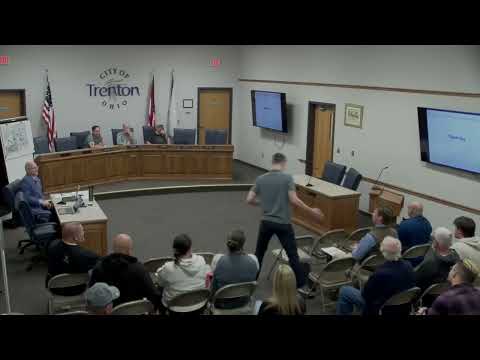
The Trenton Planning Commission recommended approval on Oct. 20 of a conditional use permit for Duke Energy27s proposed Woodsell (also referenced in materials as Wisdale/Woodsale) solar project, following more than two hours of public comment during which residents raised concerns about notification, noise, heat and effects on adjacent recreational fields.
Staff described the application as a multi-parcel utility-scale solar installation located along Pearson Road, Madison Road and Allen B Shepard Street. According to materials read into the record by the zoning administrator, the project as submitted is a roughly 59.9-megawatt installation on approximately 214 acres, about 140 of which lie inside the city. Staff said arrays, fencing and site systems were reviewed under the city27s conditional-use standard for solar (cited in-session as section 125817) and that the application included a noise study, glare assessment and a decommissioning plan.
Residents across Pearson Road said they either received only a week27s notice or no direct contact and challenged several technical and community impacts cited by the applicant and staff. "A letter I got a week ago saying 'come to this meeting because you live under 400 ft'" said one resident who said earlier outreach would have been more respectful. Neighbors asked how the city determines who gets mailed notices, who maintains vegetative screening and whether the panels and associated equipment would be audible or create localized heat effects.
Duke Energy representatives said they conducted public outreach, including postcards and a June 25 open house. "We sent postcards out in early June and held a June 25 open house," said a Duke representative, who added that contact information was provided on that mailing. Duke27s consultants and staff told the commission that the application materials include a glare study and a noise study that showed a modeled 49 dB at the relevant property line, under the city27s 50 dB daytime maximum for the industrial-to-residential edge cited by staff.
Residents pressed the applicant and staff on the basis and distance of the noise readings, on whether panels are fixed or tracking, and on long-term maintenance. One resident asked whether the panels would be visible from bedrooms and whether vegetative screening would mature quickly enough to block the view. Planning staff said the submitted landscape plan meets code lists for approved plantings and committed to enforcing maintenance requirements if plantings fall below the standards included in the submitted materials.
Soccer club volunteers told the commission they had not been contacted previously and asked about potential impacts to fields used for youth play. "We were never notified," said a soccer-board representative; staff replied that the parcel is Duke-owned and that notice is triggered by proximity buffers applied to parcel boundaries in the county GIS tax database, which can miss lessees or sublessees who use the land.
Staff explained procedural options and enforcement: if the planning commission denies a compliant application the applicant may appeal to the board of zoning appeals, and city council may revoke a conditional use permit later if conditions are not met. Staff said the city would require additional final site plans, electrical permits and other documentation before construction.
After testimony and applicant responses the planning commission took a motion to approve the conditional use. Commissioner Melo moved to approve; the motion was seconded and passed on a roll-call vote by the three members present. The commission27s approval is a recommendation in the process; subsequent final site-plan submittals and permitting steps remain before construction can begin.
Actions and next steps include distribution of final construction drawings, electrical permits, and ongoing code enforcement responsibilities for vegetative screening and noise if complaints arise. Residents were directed to the Nov. 6 city council agenda for the next formal opportunity to present comments to council members.
The planning commission27s discussion and the vote focused on whether the written application met the city27s conditional-use criteria rather than on broader policy considerations about siting utility-scale solar near housing.
Ending: The commission27s favorable recommendation moves the matter forward in the municipal review process; final approvals and permit clearances will determine if and when construction begins.