Get Full Government Meeting Transcripts, Videos, & Alerts Forever!
Get email alerts on the Industrial Development topic
No spam. Unsubscribe anytime.
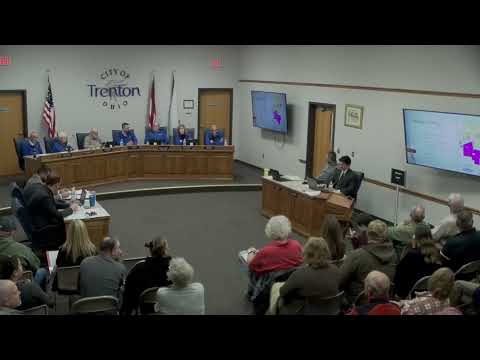
Trenton council work session tackles industrial park expansion and potential data center; residents press water, noise and oversight concerns
Summary
At a Nov. 6 work session residents pressed council and staff about a proposed industrial park expansion and rumors of a data center. Officials said no site plan or abatements have been finalized, described zoning and permit steps, and outlined water, wastewater and enforcement safeguards while residents warned about aquifer capacity and noise.
Trenton city officials outlined the zoning process and responded to sustained public concerns about an industrial park expansion and the possibility of a large data center during a Nov. 6, 2025 council work session.
Councilman Nichols explained how rezoning works in Trenton: an owner submits an application, council reads an ordinance at first reading, the planning commission reviews and holds a public hearing after legal notice (no sooner than 30 days), and council may later adopt or reject the rezoning. Nichols said the 2022 comprehensive plan identifies future land‑use designations but does not itself rezone property.
Nichols and staff described Phase 2 of the industrial park (roughly 200 acres north and south of Penel Road) and said permitted uses within the general industrial (IG) district are broad, while certain projects — the presentation used commercial solar farms as an example — would be conditional uses subject to additional requirements including a decommissioning plan, specific noise and glare mitigation and other code conditions paid by the applicant.
On the question of a rumored data center, staff said the city had not yet received a site plan and "no abatement at all has been discussed," adding that purchases of property have occurred but negotiations, infrastructure studies and any incentive discussions would happen later if a formal proposal arrives. "We don't even know what — we have not had any negotiation with them on anything," staff said in response to residents asking whether a million‑square‑foot center was already planned.
Residents repeatedly pressed officials on water capacity and contamination risk. Staff said Trenton is the water provider within its service boundary and that water capacity and leaks are a priority: the city applies for Ohio Public Works Commission grants to replace aging mains, is replacing lines and auditing meters, and is performing leak detection. One resident cited prior water‑level impacts near Miller Brewing and said outside experts (ODNR and Miami Conservancy) had been consulted; staff said Butler County Water and Sewer treats wastewater and that large projects require on‑site testing and county review to ensure compliance with OEPA requirements. The city also noted an emergency connection to Southwest Water as a contingency.
Finance director Mr. Miscus said residential tap fees are $4,000 per home (calculated to reserve 12,000 gallons per month) and explained that industrial users are assessed proportionally; staff provided a scaled example to show how a very large industrial user multiplies tap fees and usage and noted developers pay tap and connection fees before operations commence.
Enforcement and oversight were stressed repeatedly: if operations violate noise or other code provisions, the city said it will issue daily civil citations and, if necessary, seek injunctive relief in county court; planning commission review and building permit processes are the legal checkpoints before large projects can proceed.
Why it matters: Residents said they fear large industrial users could increase traffic, raise utility rates or strain the aquifer; officials said retaining development inside the city allows greater regulatory control and captures tax, tap and income‑tax benefits that would be lost if projects locate outside city limits.
What’s next: Staff said no site plan has been filed; if a formal proposal arrives it will go through the city’s internal review, the planning commission and public hearings. Council also previewed an 'information‑technology' zoning district being added to the code as an option with additional safeguards; application of that district to specific parcels would require further public hearings and ordinance action.