Get Full Government Meeting Transcripts, Videos, & Alerts Forever!
Get email alerts on the Data Center topic
No spam. Unsubscribe anytime.
Trenton finance briefing on potential data center draws weeks of public questions on noise, water, safety and transparency
Summary
City staff presented an illustrative fiscal analysis of a potential data‑center build in the Trenton Industrial Park; dozens of residents filled the meeting to demand independent noise testing, environmental studies, emergency‑response planning and clearer public communication before any site plan is approved.
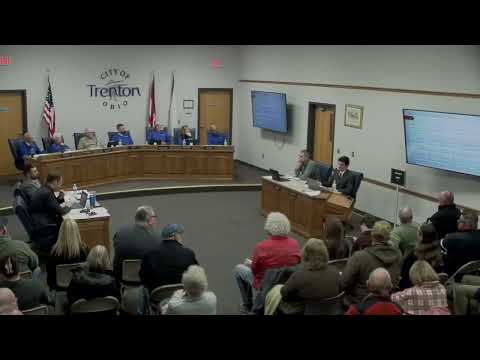
Trenton Mayor Ryan Perry convened a city council meeting on Oct. 28, 2025, where the city’s finance director gave a detailed, illustrative briefing on the potential fiscal impacts of a proposed data center on a 141‑acre parcel in the Trenton Industrial Park. The staff review, drawn from comparable Ohio projects, outlined expected building footprints, utility demand and several incentive structures the city could negotiate.
The presentation said typical configurations in Ohio include multiple 200,000‑square‑foot buildings with a multi‑year buildout; staff used example values from New Albany, Hilliard and Franklin County to show how counties and school districts and cities have treated improvement and land values for tax purposes. The finance director noted taxable valuation follows a statemandated 35% valuation rule and that actual revenue will depend on the county auditor’s valuation decisions and any negotiated tax incentives.
Why it matters: residents pressed the council for specifics and insisted that basic questions be answered before the city can responsibly consider approving any incentive package. Public comment filled more than an hour and a half of the meeting, with multiple speakers asking how the city would protect water, control 24/7 low‑frequency noise, ensure emergency response capacity, and guard against long‑term reductions in residential property values.
Residents urged independent testing and stronger conditions
“Residents are fearful,” Angie Osborne told the council, citing reports from other municipalities. “How are you going to ensure that your citizens feel safe?” Nick Simile, a nearby resident, described a “low groan” he said he hears from a local peaker plant and said he worries a data center’s continuous mechanical systems would cause chronic noise and sleep disturbance. Several speakers asked the city to require sound‑mitigation measures — such as larger setbacks, vegetative or constructed sound barriers and enforceable decibel limits — as part of any negotiation.
City staff and council members said those items are part of the site‑plan and permitting process. City Manager Nichols and legal staff said no site plans have been submitted to the city; if and when a site plan is filed it will trigger required traffic, environmental and noise studies and a planning‑commission public notice and hearing. City Staff indicated developers pay for the initial studies and the city can hire independent consultants if questions remain.
Emergency response, water and utilities also top concerns
Multiple residents asked whether the city has the fire‑suppression equipment, training and ambulance capacity a large data center could require. Council and staff answered that police and fire personnel participate in site‑plan review and that developers can be required to fund mitigation (equipment, training or station siting) or the city could require automatic mutual aid agreements during early operations.
On water and sewer, staff said the code requires connection to city utilities, that tap fees are established on peak gallons per day and that developers must pay additional fees if actual peak demand exceeds the originally agreed figure. The finance presentation modeled conservative water and sewer revenue across partial and full buildouts and outlined storm‑water fee expectations when agricultural parcels are reclassified.
Taxes, incentives and enforcement: how the numbers can change
Staff described incentive tools including tax‑increment financing (TIF), community reinvestment agreements (CRA) and county enterprise‑zone abatement. The presentation showed example scenarios where large improvement values with CRA or TIFs still produce substantial recurring payments to cities or economic‑development funds, though the precise amounts depend on negotiated terms, auditor valuations and any compensation agreements with school districts.
Council members repeatedly pointed to a recent local precedent that raised community concerns: a county abatement (the transcript refers to a Carvana example) where promised job counts were not met and enforcement at the county level proved difficult. Staff explained a city‑controlled CRA typically gives the city more direct contractual remedies and enforcement authority than a county enterprise‑zone abatement.
What the council and staff committed to do
City staff and the city attorney said the process provides multiple checkpoints: formal site plans, planning‑commission review, environmental and traffic studies paid by applicants, and the city’s authority to require independent consultants and binding mitigation in negotiated agreements. The council also noted proposed ordinance updates on the meeting agenda that clarify how noise is measured and enforced for industrial districts (the code clarifies that tests exclude generator maintenance or emergency operation but apply to normal operations).
Residents attending the meeting repeatedly asked the city to publish studies as soon as they are available and to maintain ongoing outreach. Mayor Perry and staff encouraged residents to use public‑records requests and to call city staff directly to dispel online rumors.
Next step: no site plans have been filed. If a developer files a site plan, planning commission review and required studies would follow; negotiations over incentives would begin only after technical studies and cost/benefit analysis are on the record. The city emphasized that the finance presentation was illustrative, not a promise of outcomes or incentives, and that final fiscal impacts will depend on auditor valuations, negotiated terms and independent environmental and public‑safety reviews.