Get Full Government Meeting Transcripts, Videos, & Alerts Forever!
Get email alerts on the Data Gaps topic
No spam. Unsubscribe anytime.
Modelers ask for spring locations, time‑series and better pump locational data to improve calibration
Summary
During Q&A modelers said some small springs are not well represented and that pumping was distributed where point locations are uncertain; they requested specific spring flow records and well‑location data during the comment period to refine Modflow calibration and high‑conductivity zone delineation.
Multiple attendees raised concerns about model mismatches and data gaps that limit calibration. Nick Murphy (groundwater scientist, The Nature Conservancy) cited a mapped minor spring showing an observed flow of about 47 cfs but no simulated outflow in the model, and asked how residuals between observed and simulated spring flows will be addressed. Vivec (presenter) acknowledged the discrepancy and said the team relied in part on legacy reports and geologic proxies to estimate spring locations; he asked reviewers to provide more precise spring locations and time‑series during the comment and peer‑review period so the team can refine the model.
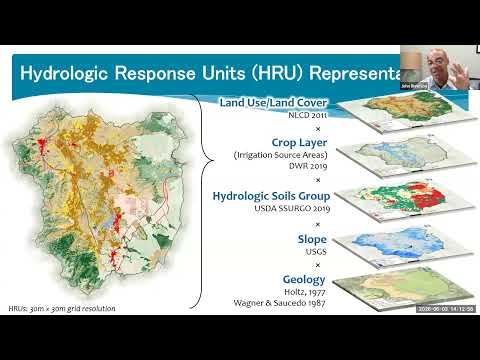
Presenters said that where exact well locations are unknown they distributed pumping area‑weighted across HRU footprints and noted this is a key caveat when evaluating single‑well impacts. The team described a path for refining high‑conductivity zones (lava tubes/basalt) by incorporating additional airborne electromagnetic (AEM) lines and well logs if available. On Dwinell Reservoir, presenters said lake‑bed conductance was treated as a calibration parameter constrained by observed lake volumes and nearby groundwater heads; they adjusted conductance during calibration to improve the water‑budget match.
The modeling team repeated that they will accept supplementary observational datasets as part of the June 12th comment period, and that providing GIS‑referenced spring locations, recent spring flow time series and parcel‑level well logs would materially improve the model's ability to represent spring discharges and local pumping impacts.