Get Full Government Meeting Transcripts, Videos, & Alerts Forever!
Get email alerts on the House Bill 332 topic
No spam. Unsubscribe anytime.
State representatives pitch link-deposit bill to help Ohio defense suppliers access loans
Summary
House Bill 332 would let the state treasurer place below-market certificates of deposit at banks so lenders could offer lower-rate loans to small defense suppliers; sponsors say taxpayers would not bear loan risk and that outreach would be led by the treasurer's office.
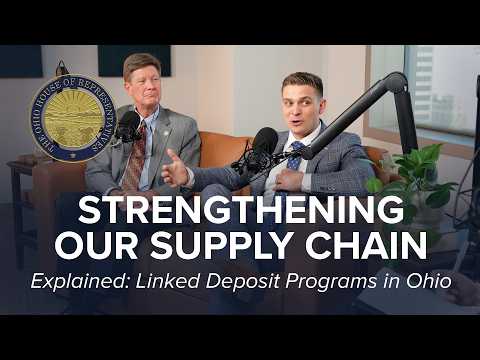
State Representatives Ty Matthews and Mark Heiner outlined House Bill 332 on the "Message from the House" program, saying the bill would create a defense-focused "link deposit" program to make loans cheaper for small and medium defense manufacturers in Ohio.
Matthews explained the mechanism as the state treasurer placing a below-market certificate of deposit at a lending institution so the bank can pass interest-rate savings to borrowers. "For an example, if I'm pulling out a loan...it could be like a 6% interest rate on that loan. If I work with a link, I can maybe knock that percentage point down to 3%," Matthews said, describing how reduced rates could lower finance costs for firms that supply defense contracts.
Both sponsors framed the bill as a tool to address a common financing problem for defense contractors: delayed government contract payments. Matthews said those payments "could be up to 120 days or longer," which makes banks reluctant to put money out for extended periods. He said placing state deposits with lenders would make institutions "more willing to push that money out," enabling suppliers to take on more work.
Heiner emphasized the sponsors' view that the proposal does not expose taxpayers to loan losses. "Those funds will come back to the treasurer's office at the end of that loan and...if for some reason the borrower defaults, the bank absorbs the risk, not the taxpayer," Heiner said.
The representatives said the bill targets what they called "small defense businesses," which the sponsors equated in the bill text to firms with up to $50 million in annual revenue. Matthews described many Ohio companies as "mom and pop tool shops" that make single components for larger platforms and said better access to credit could enable those firms to expand and win more contracts.
They argued the program could spur broader local economic activity—housing, retail and supplier networks—citing planned developments in Pickaway County as an example of projects that create vendor demand. They also placed the bill within a broader Ohio Defense Initiative, saying medtech, biotech and emerging tech sectors are intertwined with defense manufacturing and that other states and private companies have expressed interest in Ohio's approach.
On outreach and eligibility, the representatives said the treasurer's office will advertise the program and that stakeholder groups such as the Ohio Chamber of Commerce, the Ohio Business Roundtable, the Ohio Bankers League and the credit union league are likely to help notify banks and potential applicants.
The sponsors did not discuss a specific timeline for a vote during the segment. They described the policy as aimed at helping small defense suppliers access capital and said they hoped it would strengthen Ohio's defense industrial base without exposing state taxpayer dollars to loan losses.