Get Full Government Meeting Transcripts, Videos, & Alerts Forever!
Get email alerts on the Economic And Workforce Development topic
No spam. Unsubscribe anytime.
Ohio lawmakers say new law requires E‑Verify checks for commercial construction to protect local workers
Summary
State Representatives Tex Fischer and DJ Swearing described House Bill 246, signed by the governor, which requires E‑Verify screening of workers on commercial construction sites; both lawmakers said the requirement protects wages, improves safety and levels the playing field for local contractors.
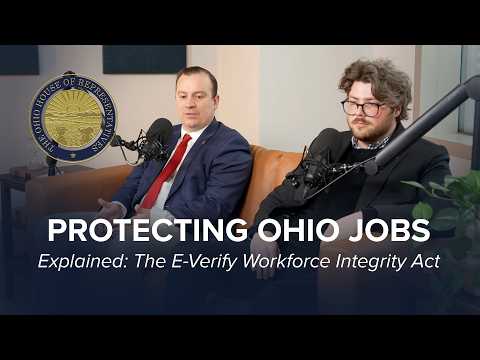
State Representatives Tex Fischer and DJ Swearing discussed House Bill 246 — the E‑Verify Workforce Integrity Act — on the "Message from the House" podcast, saying the law requires employers on commercial construction sites in Ohio to verify worker authorization through the Department of Homeland Security's E‑Verify system.
The lawmakers said the measure was carried forward from the prior General Assembly and credited former Representative Scott Wigum with early work on the issue. They described the bill as narrowly focused on construction-sector jobs and aimed at protecting Ohio workers and small businesses that hire legally. The representatives said the governor signed the bill after unanimous passage in both chambers.
Why it matters: The lawmakers argued that requiring E‑Verify will curb illegal‑labor hiring that, they said, undercuts wages and can create workplace safety risks. Representative DJ Swearing framed the problem as one that also involves exploitation: "the cartels are involved in this. It's really nasty stuff," he said, describing human‑trafficking elements the lawmakers said can accompany illegal work networks. The lawmakers said building trades and local employers supported the change.
How it works: The representatives said employers continue to collect federal I‑9 information and then submit that information to DHS's E‑Verify system, which they described as free to use and typically returning a confirmation almost instantly. They said the system is available 24/7 and was chosen as a practical, business‑friendly way to verify eligibility without adding costly new paperwork.
Lawmakers' intent and reception: Both representatives framed the law as a pragmatic, bipartisan fix. They said roughly two dozen states already use some form of E‑Verify and described Ohio as late to adopt the approach. Supporters invited to committee and attendees at the bill signing primarily included members of the building trades, who the representatives said welcomed the measure as leveling competition and improving safety. The lawmakers reported only a single late committee opponent.
Limitations and open questions: The podcast discussion presented claims about exploitation and cartel involvement as the lawmakers' framing; no additional evidence or outside testimony was presented in the episode to substantiate those assertions beyond their statements. The representatives described the law's scope as applying to commercial construction; other industries were not covered by the statute as discussed on the program.
What happens next: The representatives said the legislation is now signed by the governor and will be implemented through employer checks using E‑Verify. They did not provide an implementation timeline or enforcement details on the podcast. The representatives also noted the intent to keep the law business‑friendly and to monitor its rollout.