Get Full Government Meeting Transcripts, Videos, & Alerts Forever!
Get email alerts on the Procurement Rfp topic
No spam. Unsubscribe anytime.
Southbury task force backs single RFP to find three‑phase food‑waste program partner
Summary
The Southbury Sustainable Materials Task Force voted to issue one request for proposals covering all three grant phases (groundwork, launch, monitoring) to select a program partner for a food‑waste program, after debating vendor eligibility, DEEP requirements and proposal timelines. Members also set a tentative procurement schedule and agreed to circulate a revised draft for town review.
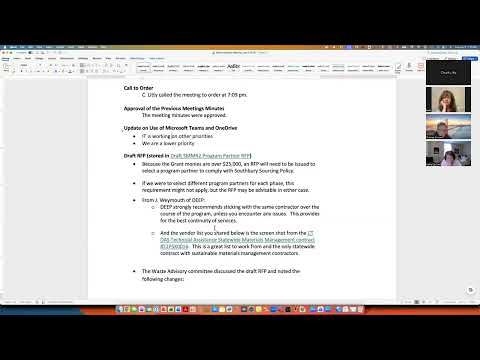
Members of the Southbury Sustainable Materials Task Force agreed to issue a single request for proposals covering all three phases of a state grant‑funded food‑waste program, the group decided after more than an hour of review and debate.
The vote followed discussion of procurement rules and DEEP guidance: the task force leader said the town must issue an RFP because the grant exceeds $25,000 and DEEP “strongly recommends sticking with the same contractor over the course of the program,” though that recommendation is not mandatory. Participants wrestled with whether to require one contractor for all phases or to break the work into three separate procurements that would let the town stop after phase one if it chose.
Supporters of a single RFP said it will streamline evaluation and avoid asking firms to submit three separate proposals. “If you fill out one RFP and you list all the things that you're willing to do for each phase, that still gives us the information we need to determine” whether to use one contractor or split phases, a task force member said. Opponents worried a single contract could lock the town into a multi‑year commitment and limit options if a vendor’s recommended approach—such as a pay‑to‑throw bag system—proved unacceptable to the town.
The draft RFP discussed in the meeting laid out three phase budgets that members referenced repeatedly: groundwork ($17,000), launch ($105,160) and monitoring ($35,000). Members also debated technical requirements in the draft: whether references should be limited to projects in the last five years, whether firms must be Connecticut‑based or have projects performed in Connecticut, and what minimum qualifications and scoring criteria the town should use. The group agreed to refine evaluation criteria so that the award remains consistent with the town’s purchasing policy to select the lowest responsible, qualified bidder.
Participants discussed procurement timing and the Q&A process. The group favored posting a 30‑day solicitation window, giving bidders roughly a week before proposals are due to submit initial questions and giving the task force time to post public answers; they also discussed scheduling candidate interviews about a week after proposals close and bringing a recommendation to the Board of Selectmen for final action. The moderator said the town attorney and procurement staff will review boilerplate contract language and DEEP requirements before posting.
A motion “that we do this as one RFP for all three phases” was made and seconded; the task force conducted a voice vote and confirmed agreement to proceed with a single RFP. The moderator said she will incorporate the meeting’s edits, circulate a revised draft and forward it to town procurement for legal review. The group set a follow‑up meeting to continue remaining agenda items and prepare evaluation materials.
The task force repeatedly emphasized that selecting a program partner through the RFP is meant to yield options and local public education in phase one, not to commit the town to a final implementation approach: phase one is framed to define a recommended local program and to give the town a clear decision point before spending grant funds on later phases.