Get Full Government Meeting Transcripts, Videos, & Alerts Forever!
Get email alerts on the School Funding topic
No spam. Unsubscribe anytime.
Survey projects narrow voter support for $33.6M West Central Area consolidation; gym add-on likely to fail
Summary
A consultant's community survey projects 52.5% voter support for a $33.6 million consolidation plan for the West Central Area School District but finds a $3.6 million gym expansion would likely fall short, and the projection lies within an estimated ±4.7% margin of error.
Darren Sievers, project manager with School Perceptions, told the West Central School Board that a community survey his firm conducted projects 52.5% voter support for a $33.6 million plan to consolidate district schools into a single K–12 campus, but that a proposed $3.6 million gym expansion would likely fail if placed on the ballot.
"Our projection of voter support is 52.5% of the voters would say yes to this project," Sievers said, and he added that the consolidated plan would save an estimated $600,000 a year in operational costs compared with remodeling three separate buildings.
The survey sample included 464 responses — a roughly 17% response rate — and School Perceptions calculated a margin of error of about 4.68%. Sievers cautioned that, because the district is small, that margin means the projection could swing several points either way: "that number could be off by 4% to the positive or the negative," he said, placing the result within statistical uncertainty.
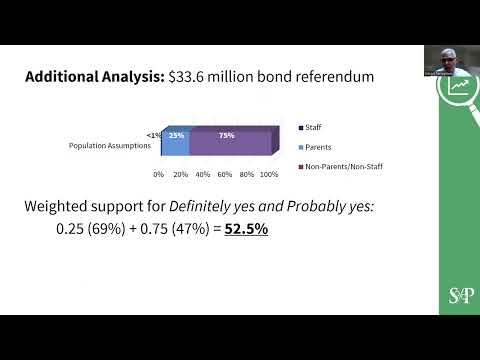
Sievers explained how the firm adjusted raw support figures into a voter projection. Unweighted responses showed broad support among staff and parents — 85% of staff and 69% of parents said they would "probably or definitely" vote yes — while non-parents/non-staff were less supportive. Because employees and parents are not proportional to the eligible-voter population, School Perceptions reweighted those groups (staff are, he said, less than 1% of eligible voters; parents account for about 25%). After weighting, the firm’s projection was 52.5% yes.
On financing, Sievers said roughly half the $33.6 million plan is expected to be covered by a state aid program School Perceptions referred to as the "Ag to School Credit," which the presentation estimated at about $16.8 million toward the project. To help voters assess personal cost, the firm prepared tax-impact charts that translate the remaining local share into annual and monthly amounts across representative property valuations.
When respondents were asked whether they would support adding an expanded gym and multipurpose facility for $3.6 million, support dropped. Sievers reported that, after weighting, the gym question would receive approximately 41.3% support and concluded, "this question, if put on the ballot, would not pass."
The presentation also included satisfaction and recommendation metrics. Using a 1–4 satisfaction scale, West Central’s composite scores were generally at or above the midpoint used for comparison districts. On a 0–10 likelihood-to-recommend question, the district scored 6.77 overall, with 51% of respondents giving an 8–10 rating; Sievers said high scorers tend to be the strongest supporters of the consolidation plan.
Sievers’ closing recommendation was procedural: the data show enough support for the board to consider placing the $33.6 million consolidation option on the November ballot, but the margin of error and subgroup weighting introduce meaningful uncertainty. He said the report and tax-impact materials will be posted on the district website and emailed to staff and parents for broader review.