Get Full Government Meeting Transcripts, Videos, & Alerts Forever!
Get email alerts on the Impact Fees topic
No spam. Unsubscribe anytime.
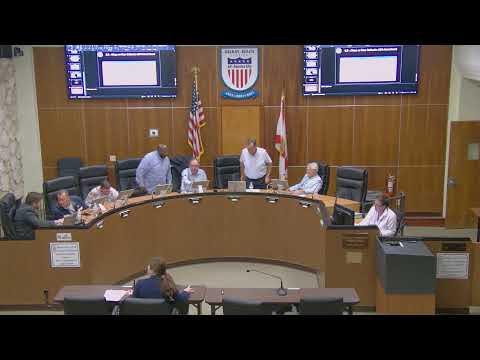
Delray Beach planning panel backs framework to adopt new developer impact fees
Summary
The Planning & Zoning Board on June 15 recommended the City Commission approve ordinance 34-26 to adopt a new schedule of impact fees and formally adopt a supporting DTA study; board members asked the commission to include incentives for workforce housing and historic-preservation exemptions. The recommendation passed unanimously.
The Delray Beach Planning & Zoning Board on June 15 voted unanimously to recommend that the City Commission adopt ordinance 34-26, which would establish a new Article 8 creating a framework and schedule for municipal impact fees based on a recently completed professional study.
Staff presenter explained the ordinance and the required legal footing under the Florida Impact Fee Act, saying the city must adopt fees based on a study using data collected within the past four years and completed within 12 months of adoption. "The only impact fee that the city collects for the city is a parks fee, and it is a parks fee that I believe has been frozen in time for well over 20 years," the presenter said, noting the current parks fee is $500 per residential unit or hotel room.
The ordinance would create several categories of fees — including municipal administration, police, fire, parks, water and wastewater — and provide detailed rules for credits, appeals and annual review tied to the city's capital improvement program. Staff described sample calculations: under the maximum fee schedule used for illustration a 2,000-square-foot home could face a one-time impact fee in the range the presenter identified as about $12,757.50, and a hypothetical 267-unit project could face roughly $2,000,000 in impact fees under the highest-adoption scenario.
Assistant City Manager Jeff Horace emphasized that the fees are charged only on new development, not on existing residents. "This is not paid by existing residents. It is paid on new development," he said, adding that fee revenue must be kept in dedicated funds and spent for the specific capital categories they were collected for.
Board members pressed staff on several implementation details: whether water and wastewater were included in the ordinance's definitions (staff confirmed language edits can clarify inclusion), how accessory dwelling units and additions are treated (the proposal exempts additions under a 1,000-square-foot cumulative threshold but would assess fees for new ADUs), and how credits for prior on-site development are calculated (impervious-surface/ERU approaches were described). Multiple members urged the City Commission to consider targeted incentives: an expanded, sliding-scale reduction for workforce housing units and fee relief for historic-preservation projects. One board member proposed "at least half" as an illustrative discount for substantial workforce-housing commitments; the board ultimately instructed staff to recommend workforce-housing and historic-preservation incentives to the Commission rather than setting an exact percentage.
Staff also noted the origin of the initiative: the fire department sought a funding mechanism to ensure new development helps pay for future facilities so growth could continue without shifting the entire cost to existing taxpayers. Staff reminded the board that impact fees are collected at building-permit issuance and that credits and long‑dormant approvals affect how fees apply.
The board moved, seconded and approved a recommendation to the City Commission to adopt ordinance 34-26, along with the additional recommendation that the Commission consider incentives for workforce housing and historic-preservation projects. The matter now proceeds to the City Commission for final action.