Get Full Government Meeting Transcripts, Videos, & Alerts Forever!
Get email alerts on the Add On Netting It Costs topic
No spam. Unsubscribe anytime.
PURA presses United Illuminating on rising IT costs, procurement and labor for add-on netting project
Summary
At a Public Utilities Regulatory Authority hearing, staff questioned United Illuminating about why IT implementation costs for add-on netting and related billing enhancements exceeded earlier estimates, how the company evaluated procurement and vendor risk, and whether cumulative labor and costs were disclosed in prior dockets.
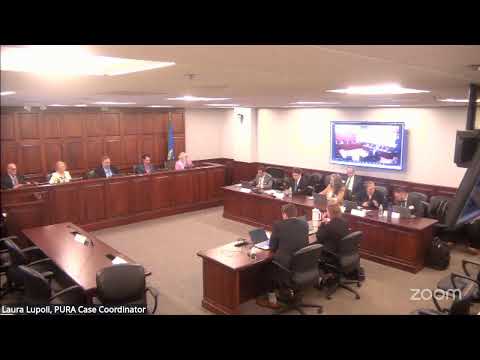
At a June hearing before the Public Utilities Regulatory Authority (PURA), commissioners and staff pressed United Illuminating Company officials about why IT implementation costs tied to an ‘‘add‑on netting’’ billing project and related program work grew substantially beyond earlier estimates and whether the company should have pursued a new competitive procurement.
Christopher Arpin, an authority staff attorney, told the panel he would focus on late‑file Exhibit 3 and the company’s add‑on netting project and asked for specifics about scope changes the company said arose from PURA directives in dockets 240803 and 240802. Arpin noted the authority had previously declined a roughly $650,000 estimate for netting implementation before approving a materially reduced estimate of about $300,000, and he asked why the company continued project work when total actual IT implementation costs later exceeded $1,000,000. "Given this history, why did the company continue moving forward with the project after it became aware that total actual cost would exceed $1,000,000?" Arpin asked.
Katarina Miller, a company manager testifying for United Illuminating, said earlier estimates were preliminary and made without vendor input. She said some elements — multifamily affordable housing (MFAH), SAM (state, agricultural and municipal projects) and RS/NRES add‑on netting — share SAP allocation tables, workflows and testing scripts, so implementing multiple directives together produced coding and testing synergies. Miller said the company had provided cost details in interrogatory responses and that stand‑alone add‑on netting line items differ from combined project totals.
On specific numbers, staff pointed to figures in the company’s attachments: an approximately $583,000 line tied to MFAH billing changes; vendor invoices and monitoring that produced combined vendor‑informed estimates in the $468,000–$475,000 range at one point; and an overall IT implementation line that the company reported at about $1,260,000. Miller told the authority that the revenue requirement actually at issue in the RAM filing was roughly $300,000, while the total project cost was larger.
Staff also emphasized labor scale. CAE 53 Attachment 1 lists roughly 15,000 labor hours for ARRES, 4,400 for MFAH, 7,700 for RS add‑on netting and 9,400 for NRES SAM — about 36,500 hours in total. Authority counsel said that total is equivalent to a single full‑time employee working 40 hours a week for roughly 17.5 years and asked whether internal staff hours were already being recovered through other mechanisms. United Illuminating witnesses said these hours were primarily external/vendor hours that were validated against invoices, that the work was capital‑based, and that capital labor was carved out of the revenue‑requirement calculations to avoid double recovery.
Procurement and vendor selection were central lines of questioning. Staff asked why the company did not run a new competitive solicitation given the scale and cumulative work the integrator (identified in the filings as WIPRO) was performing concurrently on the billing system (add‑on netting, LIDAR implementation, arrears‑forgiveness and payment‑plan changes). United Illuminating witnesses said the company relies on a procurement framework and that tight PURA‑directed timelines, the highly customized state of their billing platform and concerns about onboarding a vendor unfamiliar with the system supported continuing with the existing vendor. Miller also said the company used fixed‑price terms on the add‑on‑netting engagement so that the vendor, not ratepayers, would bear certain overrun risks.
Authority staff pushed on disclosure and timing: while prior dockets did not ask for a single combined implementation total in one place, staff said it would have expected notice earlier in light of the closely related projects and past rulings about netting‑implementation prudence. Company counsel and witnesses replied that the projects were implemented pursuant to PURA directives and that cost and hours were disclosed in interrogatories and late‑file responses in this RAM docket.
Russ Bowman, a PURA staff attorney, summarized staff’s concern about back‑and‑forth estimates and asked whether the company proactively alerted PURA when vendor invoices and projections began to show significantly higher cumulative costs; company witnesses said detailed cost information was supplied in the interrogatory responses in the current proceeding and that procurement policies had been followed.
The hearing record shows a mix of disputed points and clarifications for the authority to resolve in briefing: staff has highlighted a series of estimate revisions and the cumulative labor and vendor engagement; the company has pointed to vendor‑informed revisions, implementation synergies that it says lowered net costs relative to separate projects, and that timelines and scope were driven by prior PURA orders. The panel set a schedule for further filings: briefs due June 22, a proposed final decision targeted July 17 (exceptions due July 29), and a possible commissioners’ vote at the August 19 meeting.
Why it matters: the questions cut to ratepayer exposure and the authority’s oversight of billing‑system changes. If the authority finds the company should have provided earlier notice or pursued a competitive procurement given scale and risk, that could affect whether costs are allowed into rates. For now the record shows detailed interrogatory disclosures and conflicting views about when and how cumulative cost and vendor‑selection issues should have been presented to PURA.
The hearing record remains open to briefing and, per the authority’s schedule, the matter will proceed through a proposed decision and potential vote later this summer.