Get Full Government Meeting Transcripts, Videos, & Alerts Forever!
Get email alerts on the Police Recruitment topic
No spam. Unsubscribe anytime.
OLO presents recruitment strategies as MCPD seeks to boost and retain officers; leaders note applicant surge but quality concerns
Summary
The Office of Legislative Oversight presented a report compiling recruitment strategies used by Fairfax, Dallas and Phoenix and recommended surveying officers and cadets; Montgomery County Police leaders said applicants rose from about 850 to nearly 1,500 but warned attrition and candidate quality remain challenges.
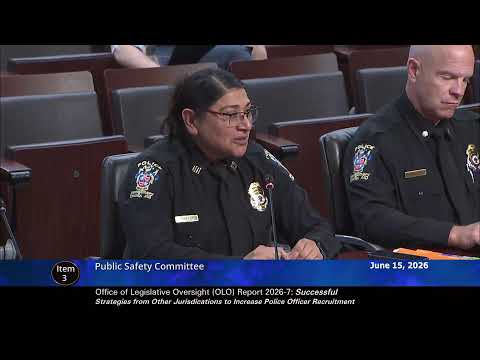
The Office of Legislative Oversight (OLO) briefed the Montgomery County Public Safety Committee on Monday on successful recruitment strategies used in comparable jurisdictions and offered recommendations the county’s police department could adopt to increase sworn hires.
Gabriela Reynolds, an OLO legislative analyst, summarized model practices — prioritizing values and skills, emphasizing community alignment, expanding youth pipelines and cadet programs, targeting women and BIPOC candidates, and streamlining the hiring timeline. Reynolds noted the report reviewed Fairfax County, Dallas, and Phoenix as case studies and recommended the county survey current officers and cadets to better understand what attracts and retains candidates.
"This study focuses on sworn personnel as most of the recruitment gaps and challenges happen in these ranks," Reynolds said. She recommended a two‑part survey: ask officers why they joined MCPD (including the role of hiring bonuses) and ask cadets what supports would encourage them to pursue a sworn career.
Assistant Chief Nicholas Augustine and personnel leaders described a notable increase in applicants but cautioned that many candidates do not complete the entire hiring process. Augustine said the department had grown applicant counts from about 850 to nearly 1,500 and has formed a cross‑bureau work group to reduce attrition and improve communications with candidates. Captain Kathy Estrada described outreach efforts including 118 career‑fair events, partnerships with Montgomery College and University of Maryland at Shady Grove, two high‑school law enforcement leadership sites at Seneca Valley and Thomas Edison, and a "super Saturday" model to complete multiple screening steps in one day.
Staff also said policy changes — loosening a three‑year cannabis restriction and revising college‑credit requirements — expanded the applicant pool; staff reported 989 applicants for a current academy class and 1,466 for a July class. Officials said many applicants still drop out early in the funnel, and the department is trying to streamline conditional offers, medical and psychological scheduling, and background investigation steps.
Committee members praised the report and offered suggestions ranging from childcare stipends for recruits and employees to targeted outreach to athletes and high schools. Officials urged council members to attend recruitment events and use council communications to amplify department outreach.
What happens next: OLO recommended surveys of officers and cadets; department staff said it will continue implementing outreach changes, evaluate the July academy yield, and report back on work group findings.