Get Full Government Meeting Transcripts, Videos, & Alerts Forever!
Get email alerts on the Coastal Flooding topic
No spam. Unsubscribe anytime.
Consultants warn Fresh Pond faces increasing saltwater intrusion risk; recommend culvert work and backflow prevention
Summary
A consultant presented a high-resolution hydrodynamic update showing rising storm and sea-level-driven flood probabilities into Fresh Pond and Pulpit Harbor; the study ranks alternatives and recommends culvert modification plus road raising (Alternative C2) as the most durable approach, and staff has applied for a Community Action grant to fund design work.
Scott, a consultant presenting for the study team, told the North Haven Select Board on Dec. 18 that instrumented tide gauges and a higher-resolution hydrodynamic model show growing risk of saltwater intrusion into Fresh Pond and Pulpit Harbor.
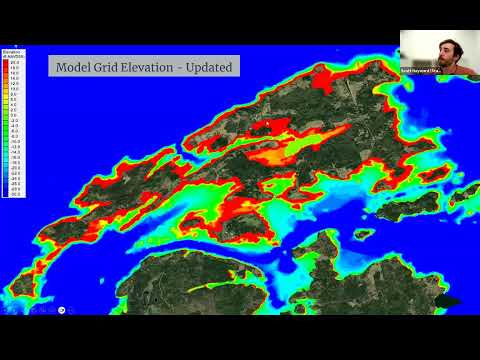
Scott said the project deployed multiple gauges on North Haven, validated an updated model against observations and reran about 30 historical storm scenarios to produce cumulative-probability flood curves. "Based just on all the numbers, Alternative C2 was the most effective," he said, describing C2 as a Middle Road culvert modification combined with raising the roadway to reduce backflow into the pond.
The study team presented tables translating storm-return periods into the chance that specific water levels will be reached in a given year. Scott summarized one headline finding: storms that now rank as rare become substantially more probable when sea-level rise is included, and a roughly 10.5-foot event — presently a multi-decade storm — becomes more likely than not within about 15 years under the study's scenarios.
The consultants evaluated three location-based alternatives (A at Dam Road, B at Middle Road, and C at Middle Road with backflow prevention) each with two suboptions (1 = road left at present profile, 2 = road-raising included). They said A1/A2 (Dam Road-focused fixes) are relatively effective short term but would require large amounts of fill and lose effectiveness past 25 years; B1/B2 are intermediate in cost and performance; and C2 (installing backflow prevention on Middle Road and raising the road profile) provided the most durable reduction in salinity intrusion across modeled time horizons.
The team described technical measures including replacing culverts, installing one-way backflow devices (examples given: duckbill or flap gates) and raising roadway invert elevations to limit overland flow into Fresh Pond. Scott noted the modeling used NAVD88 datum and combined tidal and storm surge statistics with projected sea-level rise to estimate cumulative probabilities of extreme water levels.
Board members asked how the measures would affect normal pond flushing. Scott said backflow prevention restricts reverse flow during storms but would allow tidal exchange under nonstorm conditions once water levels recede. Alice Cornwell asked for datum clarification; Scott explained NAVD88 and related mean-sea-level references used in the report.
Select Board members and staff discussed next steps and funding: staff reported a Community Action grant was submitted to fund further design, community engagement and 100% design work; Claire said notifications for that funding are typically made by March and likely January–February next year. The board discussed whether to budget for preliminary design if the grant is not awarded and whether to begin an RFP process to gauge engineering interest.
Why it matters: Fresh Pond is a drinking-water source for the island; increasing odds of storm-driven saltwater intrusion would compromise water quality during events and raise long-term infrastructure and public-safety questions. The study gives the town engineering options and a technical basis for grant applications and capital planning.
What comes next: staff said the Community Action grant, if awarded, would fund further analysis and community outreach through a 100% design phase; otherwise the board could place a warrant article before town meeting or call a special town meeting to allocate local design funds. The board did not adopt a specific construction plan at this meeting.
Sources and provenance: the article draws on the consultant's presentation and Q&A to the Select Board (presentation began SEG 030 and concluded SEG 686).