Get Full Government Meeting Transcripts, Videos, & Alerts Forever!
Get email alerts on the Documentary Screening topic
No spam. Unsubscribe anytime.
Scholars at Concord screening praise new Thoreau documentary for reframing his legacy
Summary
At a Concord Free Public Library screening, scholars praised a three‑hour documentary that foregrounds Thoreau’s environmental urgency and local Black history, lauding its handling of Thoreau’s journal and its reach for contemporary relevance.
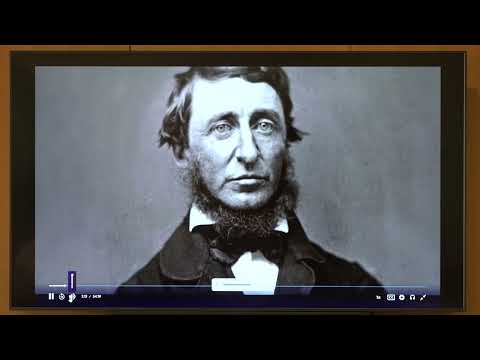
On an evening at the Concord Free Public Library, scholars and community members gathered to watch clips from a new three‑hour documentary about Henry David Thoreau and to discuss the film’s themes and production. John Cusk, co‑president of the Thoreau Alliance, opened the program and credited filmmakers Chris and Eric (the UR brothers), Ken Burns, the Walden Woods Project and a large group of scholars and technicians for the decade‑long project.
Rebecca Neil Gould, who teaches in an environmental studies program and spoke on the panel, said the filmmakers’ choice to lead with Thoreau’s voice juxtaposed against contemporary images was “so effective” and “really powerful.” She said the opening sequence forces viewers to confront Thoreau’s central questions: “Who are we? Who am I? What’s it all about?” and praised the film’s effort to represent the scale and variety of Thoreau’s two‑million‑word journal.
Panelists also highlighted the film’s effort to put previously marginal local figures into the historical narrative. Elise Lamir, a retired professor of literature, said the film brought names such as Bristo Freeman and Zila White onto the screen in ways that move them from periphery to mainstream local history; she called that decision “very gratifying.”
Scholars on the panel described the documentary as ambitious in scope, commending the editors’ choices to balance literary, ecological, and social contexts while acknowledging that many lines of scholarship and story were necessarily left out. The audience Q&A ranged from Thoreau’s anecdotes for children to discussions of his teaching style and his practice of journal writing.
The event closed with panelists and audience members encouraging wider use of the film in classrooms and public programming. Cusk noted upcoming related events, including a prize ceremony and other public forums, and thanked the library staff and volunteers who helped host the screening.