Get Full Government Meeting Transcripts, Videos, & Alerts Forever!
Get email alerts on the Jail Site Selection topic
No spam. Unsubscribe anytime.
City and County Form Public Working Group to Recommend One Site for New Monroe County Jail
Summary
A joint Monroe County and Bloomington City council session on June 11, 2026 created a public, time‑bound working group charged to evaluate two to three candidate sites, assess zoning and feasibility, and return a single recommended location within one month; the motion passed unanimously by both bodies.
A joint meeting of Monroe County council and the Bloomington City Council on June 11 produced a formal, public working group to advance selection of a site for a new county jail and to return a recommendation within one month.
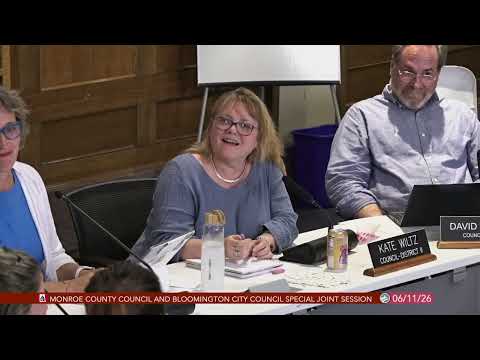
At the meeting, co‑facilitator Kate Wiltz said the session’s purpose was to "align around where we are in this process" and to identify next steps so construction can proceed. Wiltz told the assembled officials the city does not oversee jail operations but "the jail impacts our entire community" and city support could be important during site review.
Discussion centered on three recurring themes: site control and legal permissibility, construction and operational feasibility, and a fiscal path that would be defensible in federal litigation. Commissioner Madira summarized six evaluation factors members should apply when vetting sites, including county ownership or rapid acquisition, clear zoning or permitting paths, minimal design or utility barriers, confirmation from the sheriff and design professionals that the site can meet operational needs, and a funding/timeline approach that could withstand court scrutiny.
City planning staff and council members described the local review process for large projects. City staff said some site plans can be handled administratively, while larger proposals generally require plan commission review and sometimes city council action; an expedited, fully complete application could clear the city review process in about four months in a best‑case scenario, although six to nine months is more common.
The Thompson site was discussed at length. City planning staff relayed that an earlier PUD amendment (PUD 1202) allows a jail as a permitted use in Tract D but requires plan commission site‑plan approval; associated materials previously referenced about 170,000 square feet and 400 beds as the basis for the PUD. Council members also raised the possibility of phased or collocated solutions using existing county properties such as the Curry building while stressing that many technical and operational constraints remain.
After debate over transparency and process, council members moved to form a public, time‑bound working group. The motion—drafted so the subgroup would identify two to three candidate locations, assess zoning and other implications for each, and return a single recommended site—passed unanimously on roll call in both the city and county councils. Members agreed the subgroup’s meetings must be publicly noticed and that sheriff, prosecutor and public defender offices should be invited to participate or advise the panel. The bodies set a target to reconvene the larger group in about one month to hear the subgroup’s recommendation.
The councils did not make a final site decision at the meeting. Officials stressed that litigation considerations and outstanding questions about whether the existing facility can be remediated will continue to influence timing and options. The working group was charged to gather the relevant documentation, vet sites against the agreed factors, and deliver a recommendation to the joint body.