Get Full Government Meeting Transcripts, Videos, & Alerts Forever!
Get email alerts on the Pension Assumptions topic
No spam. Unsubscribe anytime.
Oklahoma City pension board defers adoption of actuarial assumption changes after experience study review
Summary
After reviewing a six‑year experience study showing higher retiree deaths and mixed retirement/turnover patterns, the board deferred adoption of proposed mortality and economic assumption changes to its July 9 meeting to allow members more time to review the data.
The Oklahoma City Employee Retirement System board received a presentation on an experience study covering Jan. 1, 2019–Dec. 31, 2024 and voted to defer action on proposed assumption changes until its July 9 meeting.
France Peterson, the consultant presenting the study, told trustees the six‑year review was chosen because COVID‑19 produced unusual experience that warranted an extra year of data. "Normally we do experience studies every 5 years," Peterson said. She said the consultant team recommended moving only partway toward recently observed changes—"we recommend moving only a quarter of the way toward your actual experience"—so the board would not overweight pandemic-era anomalies.
The study separated demographic and economic assumptions. On retirements Peterson said the study observed 140 age‑based retirements (versus 192 expected) and 258 service‑based retirements (versus 185 expected), and explained these patterns and exposures would put modest upward pressure on liabilities because more members fall into the service‑based category. On disability Peterson said there were only three disability retirements over six years (about 13 were expected) and recommended no change because the sample was too small to be credible.
Peterson reported 321 retiree deaths over the six‑year window versus roughly 190 expected and attributed much of that excess to COVID‑19. She recommended the plan move from the RP‑2014 mortality table to the more recent PUB‑2016 family of tables published by the Society of Actuaries, with limited local scaling to reflect Oklahoma experience. "We recommend going to the PUB‑2016 table," she said.
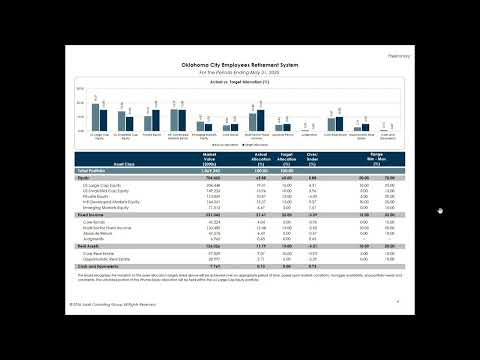
On economic assumptions Peterson recommended modest adjustments: raising price inflation from 2.25% to 2.50% and wage inflation from 3.00% to 3.25% (maintaining roughly the same spread historically used for the plan). She reviewed investment return expectations tied to the plan's asset mix (about 25% fixed income, 60% equities, 15% real estate) and said short‑term consultant medians were about 6.71% and long‑term medians about 7.16%; the consultant recommended leaving the plan's discount rate at 7.00%.
Using valuation scenarios Peterson showed the plan's Dec. 31, 2024 figures (as presented) included about $994 million in liabilities, a city contribution requirement of about 8.4% ($18.1 million) and a funded ratio near 94.3%. She said applying the proposed demographic and economic changes would reduce liabilities by roughly $16 million and raise the contribution rate slightly (to about 8.48%, or roughly $300,000 more). By contrast, lowering the discount rate to 6.75% in an alternate scenario would add about $29 million in liabilities and raise the contribution to about 10.31%, putting the city contribution above the 10% cap the packet referenced.
Board members pressed the presenter on data limitations and local comparability: one trustee asked whether cause‑of‑death statistics are available for the system; Peterson said they are not. Members also asked whether smaller, local plans could be used as comparators; Peterson said small plans lack the credible exposure to replace Society of Actuaries national tables and that OPERS (the state plan) was used as a local benchmark where useful.
After discussion a trustee moved to defer consideration of the proposed assumption options (items 10B–10H) to the July 9 meeting so members could study the data further. The motion passed by voice vote. Staff asked trustees to submit additional questions to staff by June 26 so staff could coordinate responses with the actuary ahead of the July meeting.
Next steps: the board will carry current assumptions forward for the valuation if it does not adopt changes at the July meeting; if trustees vote to adopt changes at that later meeting the actuary said the valuation can be updated to incorporate them.
(Reporting: France Peterson, consultant; Jason Pulis, investment consultant; Trustee recorded vote: Trusty Davis noted as 'yes' earlier in the meeting.)