Get Full Government Meeting Transcripts, Videos, & Alerts Forever!
Get email alerts on the Capital Projects topic
No spam. Unsubscribe anytime.
Denmark budget committee weighs $600,000 salt-shed, defers some equipment purchases to limit tax impact
Summary
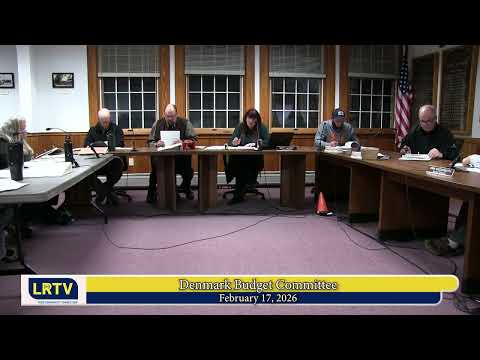
At a Feb. 17 budget meeting, Denmark officials reviewed updated fiscal-year numbers and debated whether to fund a roughly $600,000 salt/sand shed this year or reallocate capital equipment money and unassigned funds to reduce the immediate mill-rate impact.
Denmark — The town’s budget committee on Feb. 17 reviewed an updated budget packet and debated how to pay for a failed salt-and-sand shed, vehicle replacements and other capital needs without a large tax increase.
Betty, who prepared the budget packet, told the committee she added year-to-date 2026 expenditures and a four‑year comparison, and that “a net revenue so far without taxes is $724,466.” She said the auditor reported an unaudited FY25 unassigned balance of about $1.084 million and, under optimistic assumptions, the town could have roughly $683,000 available as an unassigned balance for the fiscal year being discussed.
Why it matters: the committee is weighing whether to raise or reassign money for a new salt/sand shed (modeled at roughly $600,000) and whether to push back purchases such as an excavator and scheduled truck replacements. Those choices will affect this year’s mill rate and how the town balances short-term needs against maintaining a capital-equipment reserve.
Members discussed two basic funding approaches the packet modeled. One scenario keeps the usual annual capital contribution; an alternate scenario (presented as “scenario two” in the packet) would remove the $350,000 capital placeholder from this year’s requests and instead use $100,000 from the town’s building fund plus $150,000 from unassigned balances to reduce the immediate tax hit. Committee member Russ described the latter as the more prudent short-term path to reduce near-term tax pressure.
The committee also heard that the town’s vendor for transfer-station hauling submitted proposals that, if signed before the vendor’s deadline, would let Denmark remain on current rates through September; otherwise the town faces higher rates, including an approximate 30% increase in waste charges and a roughly 13% rise in recycling fees.
Public-notice concerns arose after members recounted the recent demolition of the old salt shed. An engineer’s report concluded the structure was unsafe and it was removed for liability reasons; several members said residents learned of the demolition only after the fact and urged more proactive public notice for future large-ticket emergency actions.
On equipment, public-works staff outlined competing needs: a wheeled excavator (budgeted near $195,000–$200,000 in the packet), a replacement “Wheeler” rig (roughly $190,000), and a larger plow truck (the 2016 ‘‘550’’ model replacement estimate was discussed in the $300,000+ range depending on options). Staff described how the capital‑equipment fund (which currently holds less than a full replacement amount for the listed items) could be used for part of any purchase and how deferral would reduce this year’s tax burden but could force larger payments later.
Committee members asked for more precise site and cost estimates for the salt shed and directed staff to obtain additional survey and geotechnical work (Sebago Tech was named as the engineering firm already engaged to develop site plans). Several members suggested using a relocatable (block) foundation to preserve flexibility if future site choices change.
The committee did not take a formal vote; members performed a straw poll that indicated support for the option that reduces this year’s capital contribution and draws $250,000 from building/unassigned funds to blunt the immediate mill‑rate effect. The packet and scenario worksheets will be revisited at the next meeting, when department heads and outside agencies will be scheduled to provide additional detail.
The committee also asked staff to: get firm cost estimates and timetables from builders for a salt shed, confirm contract deadlines on transfer-station proposals, continue searching for grants (including resilience and private sources), and present clearer line-item justifications and a timetable for vehicle replacements.
What’s next: members agreed to revisit the packet next week, convene department heads for more detailed Q&A, and return with engineered site plans and binding vendor timelines so the board can set a final warrant article and funding approach.