Get Full Government Meeting Transcripts, Videos, & Alerts Forever!
Get email alerts on the Public Participation topic
No spam. Unsubscribe anytime.
How Wake County families can influence boundary changes and what stability rules mean
Summary
During the May 27 engagement session staff explained the data and procedures used to evaluate boundary proposals, described expanded stability rules for some students, and detailed the summer and fall schedule for focus groups, draft maps, hearings and final board decisions.
At a public engagement session on May 27, Wake County Office of Student Assignment presenter Susan Pulliam explained to parents and residents how the district evaluates boundary-change requests and described recent stability-rule practices that affect whether students can remain at their current schools after reassignment.
Pulliam listed the four core data categories staff use when weighing boundary changes: student achievement (including socioeconomic balance), stability (cohort progression and existing stability rules), proximity (closest school with available capacity) and operational efficiency (facility utilization and transportation). “If we have a facility that has 1,200 seats and there’s only 900 students, is there a way for us to add 300 students to that campus through a boundary change? That’s just simple math,” Pulliam said.
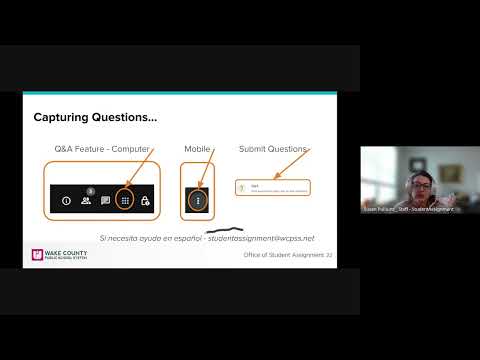
She described practical steps families can take: post and rate ideas on the thought exchange (open through May 27), use the Google Meet Q&A to flag specific boundary issues and sign up on the assignment planning website to join summer focus groups and AI-supported interviews. Staff emphasized that thought-exchange inputs and ratings are shared with the planning team and board and that the planning team carries forward ideas from prior years.
On reassignment frequency and stability, Pulliam said the district follows an internal guideline that an address should not be reassigned more frequently than every three years and that staff are trying to recommend assignments that last longer where feasible. She also described recent practice for new elementary openings: rising fourth and fifth graders have been allowed to remain at their current schools and younger siblings may remain through the end of fifth grade; staff noted that families who remain under these generous stability provisions are responsible for their own transportation, as district transportation is not provided.
Timeline and next steps outlined in the session: June–July focus groups and interviews; draft maps generated June–August; initial draft maps shared publicly and with the board in early September; public engagement through September–October including information sessions and a board-hosted public hearing in October; and a final package to the board for approval in November.
How to participate: staff asked residents to visit the assignment planning website to review materials, rate and comment in the thought exchange before it closes on May 27, and sign up for summer focus groups to provide deeper feedback that will inform the draft maps.