Get Full Government Meeting Transcripts, Videos, & Alerts Forever!
Get email alerts on the Land Use Data Centers topic
No spam. Unsubscribe anytime.
Berkeley Heights hears broad public support for draft ordinance to ban data centers
Summary
Councilmember Susan Pogue presented a draft ordinance to prohibit data centers in Berkeley Heights, citing concerns about water use, energy demand, noise and long-term infrastructure costs. More than a dozen residents and experts urged the council to adopt a ban; some council members asked for further fiscal analysis before final action.
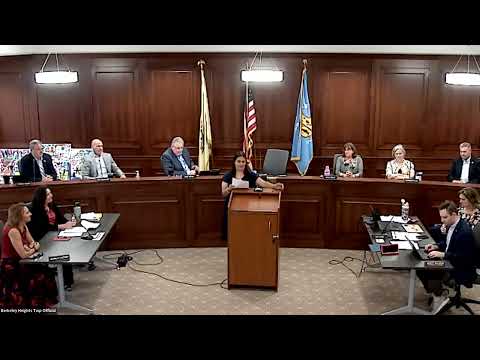
Councilmember Susan Pogue presented a draft ordinance on June 9 that would bar commercial data centers in the Township of Berkeley Heights, arguing the facilities pose long-term burdens on local water, energy and public-health infrastructure.
Pogue summarized peer-reviewed research and local concerns, saying the proposed prohibition would add a definition to the municipal code to "prohibit data centers in the township of Berkeley Heights in order to preserve the health of residents and resources in our small community." She told the council the draft was written to exclude incidental server rooms used by an otherwise permitted use.
The draft defines a prohibited data center as a facility "primarily used for the housing, operating and maintaining of computer servers and associated power distribution and cooling infrastructure for the purpose of storing, processing or transmitting digital data for third parties," and specifies the prohibition would not apply to incidental server rooms.
A lengthy public hearing followed. Residents, technical commentators and neighbors of potential sites described a range of concerns. Dana Nigro, citing research and local examples, said higher nitrogen-dioxide measurements and infrasound complaints near recent U.S. data centers had coincided with respiratory and sleep problems. "Within just a few months, residents were reporting respiratory issues flare up," she said, and pointed to published studies on local air and noise impacts.
Several speakers described data centers' heavy water and energy demands. A resident noted a Memphis facility used "more than 11 million gallons in one month," and others said state incentives and rapid-build timelines leave towns with infrastructure that outlives economic benefits.
Supporters of a ban urged pre-emptive action. Adam Harowitz told the council, "Preventing them before they come in and destroy our town rather than fighting them after the fact is a wise decision," citing limited permanent jobs and the legal costs of defending enforcement.
Some council members and residents urged additional fiscal analysis. One council member asked for a clearer estimate of net tax revenue, noting that smaller facilities and site placement near Route 78 could change the local impact. "We might be able to build a smaller data center," a member said, adding that the town should at least evaluate potential revenues and infrastructure costs first.
Legal counsel recommended a clear, narrowly tailored code amendment that cuts off the use at the source and avoids inadvertently prohibiting ordinary office server rooms. Council members said the draft could be revised and brought back; Pogue indicated the council would consider the text and possible timing for introduction and adoption at future meetings.
Next steps: the council has a draft ordinance under consideration and multiple residents requested a prompt adoption; the council has not yet scheduled final action on this specific draft. The meeting record shows broad public support for a ban, counterposed with requests for more precise fiscal modeling before adoption.