Get Full Government Meeting Transcripts, Videos, & Alerts Forever!
Get email alerts on the Public Comment topic
No spam. Unsubscribe anytime.
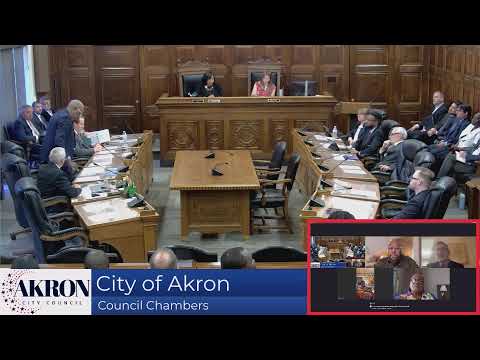
Residents press council on Ohio House Bill 249, erosion and trash pickup during public comment
Summary
Speakers at Akron City Council’s public comment period urged the body to oppose Ohio House Bill 249 for criminalizing queer performance spaces; other residents asked for city action on a damaged drain causing erosion and for ordinances to schedule street cleaning and trash pickup.
Andrew Marklin, with Akron DSA, told City Council he opposes Ohio House Bill 249, saying it would “ultimately criminalize queer performances” and make queer spaces less safe. He framed the bill as subjective enforcement — “an I know it when I see it law” — and urged council to consider whether that outcome reflects Akron’s values.
Carol Reynaldo described inheriting a house at 405 Sandhurst Road that is threatened by erosion from a damaged drain pipe in a ravine. Reynaldo said city and county personnel inspected the site after a recent storm; she asked council to determine which jurisdiction should fund or perform repairs so her property does not “eventually fall into the Summit County Park system.” The chair directed Reynaldo to meet with Chris Ludlow, director of public service, after the meeting.
Charlie Nelson urged council to adopt an ordinance that schedules street cleaning and trash pickup and restricts parking on certain days to ensure sanitation crews can access streets. He argued that some residents cannot receive services because vehicles block collection and suggested assessments or a schedule could remedy the problem.
Cindy Lawler Owens (introduced by the chair) said she had acquired an abandoned family house with tax liens and structural damage and asked for guidance on how to preserve the property. Owens also briefly recounted a traffic stop in which officers pointed guns at her during a morning work trip; she ran out of time and the chair offered follow-up after the meeting.
The chair thanked all public commenters and moved the council into the consent agenda. The public comment period closed with the council thanking participants and offering staff follow-up where requested.