Get Full Government Meeting Transcripts, Videos, & Alerts Forever!
Get email alerts on the Traffic Calming topic
No spam. Unsubscribe anytime.
Consultant and Nashville DOT propose five speed cushions and a Rainwood Drive bulb out for Morewood Drive; plan will go to property‑owner ballot
Summary
At a recorded neighborhood meeting, Kimley‑Horn engineer Chase Fuqua presented a final design to calm traffic on Morewood Drive — five speed cushions, lane‑narrowing striping and a bulb out at Rainwood Drive — and said the plan will be mailed to property owners for a six‑week yes/no ballot requiring two‑thirds approval to move forward.
Chase Fuqua, an engineer with Kimley‑Horn working with the Nashville Department of Transportation, presented a final design for traffic calming on Morewood Drive at a recorded neighborhood meeting. Fuqua said the treatment would run from Chesapeake Drive to Briley Parkway and includes five speed cushions and a bulb out at Rainwood Drive.
“The proposed layout: five speed cushions, more or less evenly spaced between Chesapeake Drive and Briley Parkway with a bulb out in the middle at Rainwood Drive,” Fuqua said, describing the recommended plan.
Why it matters: Fuqua tied the proposal to Metro Nashville’s Vision Zero goals, saying engineered speed‑reduction measures improve survival odds for people outside cars. He said the NSTC program focuses on residential streets and prioritizes proven engineering solutions to lower speeds.
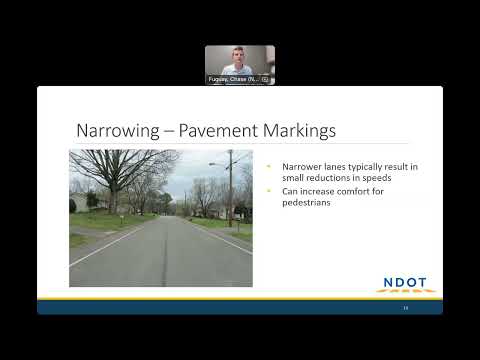
Design details Fuqua presented include modular rubber speed cushions (with gaps to allow emergency vehicles), visual lane narrowing via white edge‑line striping to create roughly 10–11‑foot lanes, and a bulb out at Rainwood Drive tightening curb radii with about 20‑foot turning radii. The design packet shows two/three‑cushion configuration options to accommodate sections with and without curb and gutter.
Process and voting: Fuqua said the NSTC program is data‑driven, considering speeds, volumes and crash history when selecting streets; he noted the program received over 700 applications last fall and typically selects about 25 streets across two cycles annually. This project is part of the fall 2025 selection cycle.
Balloting will be mailed to property owners in the project zone; voting is open for six weeks and is a simple yes/no ballot. “If 2/3 of the respondents vote yes, then the project moves forward and the design will be implemented on the street,” Fuqua said. Fuqua said each abutting property receives one ballot; vacant parcels and businesses are ineligible. He urged anyone who expected a ballot and did not receive one to contact project staff, saying his contact information was included on the meeting slides.
No formal votes or decisions were taken during the meeting; Fuqua closed by directing viewers to trafficcalming.nashville.gov and the DOT’s project materials for maps and the ballot zone. If the mailed ballot reaches the two‑thirds approval threshold, the design will be scheduled for construction and installation on Morewood Drive.