Get Full Government Meeting Transcripts, Videos, & Alerts Forever!
Get email alerts on the Traffic Calming topic
No spam. Unsubscribe anytime.
Neighbors in Nashville divided over proposed speed cushions on Estus Road
Summary
Councilmember Brenda Gad and INDOT consultant Amy Burch presented a revised traffic-calming plan for Estus Road that would place three 14-foot speed cushions and a chicane at a park crosswalk. Neighbors backed safety goals but differed on cushions, diversion risk, enforcement and the need for sidewalks; the measure will go to a mailed/online ballot to 56 property owners (66% threshold).
Councilmember Brenda Gad and an INDOT traffic engineer on Thursday presented a scaled‑down traffic‑calming plan for Estus Road that would place three speed cushions and a painted chicane at the park crosswalk and send the design to a neighborhood ballot.
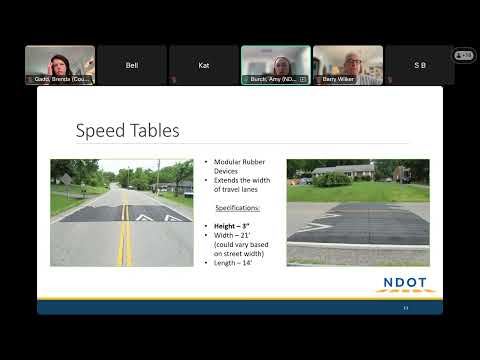
Amy Burch, a traffic engineer and consultant working with INDOT, said program data shows the corridor’s 85th‑percentile speed is about 37 mph — above the posted 30 mph — and that the program favors speed cushions because the gaps allow emergency vehicles to straddle them. “We measured the 85th percentile speed to be 37 miles an hour,” Burch said, and added that cushions and a lane‑shift chicane near the park are intended to improve crosswalk visibility and reduce vehicle speeds.
The proposal presented to residents trims the earlier concept to three sets of 14‑foot speed cushions spaced farther apart and adds a chicane and delineator posts at the park crosswalk. Burch said the design also keeps non‑vertical fallback measures ready: if vertical measures do not receive the neighborhood vote, INDOT would still consider radar feedback signs and the painted chicane.
Why it matters: Estus residents say they want safer walking access to Woodmont Park and that a multi‑part approach is necessary. Multiple long‑time residents said the lack of sidewalks is the neighborhood’s central safety problem and urged that cushions not become a substitute for sidewalks. “There’s no safe way to walk on Estus,” said Jan Houseman, who said she crosses the street daily with a disabled son.
Neighbors were split about whether cushions would help or simply divert traffic to nearby side streets. Several residents warned that cushions could push cut‑through drivers onto smaller residential streets; others argued that a reduced cushion plan, combined with enforcement, would improve safety for park users and families. “We’re here for safety — trying to keep my two‑year‑old from getting hit by a car,” resident Lydia Krauss said.
Process and next steps: Burch described a six‑week mailed/online ballot that will go to the 56 qualifying property owners along Estus; respondents can vote yes or no. “If 66% of the respondents vote in favor of the project, then it would move forward into our construction phase,” Burch said. If the ballot fails to reach the 66% approval threshold, the program would proceed without vertical measures (no speed cushions) and instead rely on non‑vertical tools such as radar signs and the chicane.
Timing and implementation: Burch said construction typically has taken eight to ten months after a successful ballot in the past, although INDOT has recently completed some projects faster. She also said raised crosswalks require additional drainage and ADA work that may fall outside the traffic‑calming program and could involve Metro Water and other funding or departments.
Questions of enforcement and data: Several residents requested more policing and data from the West Precinct. Councilmember Gad said she forwards resident requests to West Precinct leadership and that the precinct uses precision policing and data dashboards; she offered to connect residents to West Precinct Commander Jason Proctor and Sergeant Kosen for enforcement coordination.
What’s unresolved: Residents asked for assurances about how INDOT will monitor post‑installation diversion to neighboring streets and what follow‑up studies would be conducted if complaints arise. Burch said follow‑up studies can be performed and that residents should report traffic impacts so INDOT can evaluate diversion and next steps.
The ballot and project documentation will be posted on the Estus project page on the Metro engagement site after the mailed cards are sent; Burch and Councilmember Gad said they will notify residents when balloting opens.