Get Full Government Meeting Transcripts, Videos, & Alerts Forever!
Get email alerts on the Developer Advice topic
No spam. Unsubscribe anytime.
Developers, Hinesburg committee members tell Richmond: streamline rules, build partnerships to deliver housing
Summary
Guests from Hinesburg and a local developer told Richmond’s committee that clear zoning, committee–staff alignment, diversified project types and municipal incentives (fee waivers, tax abatement) make inclusionary and perpetually affordable housing feasible even at current costs. They urged building readiness and community outreach before asking voters for funds.
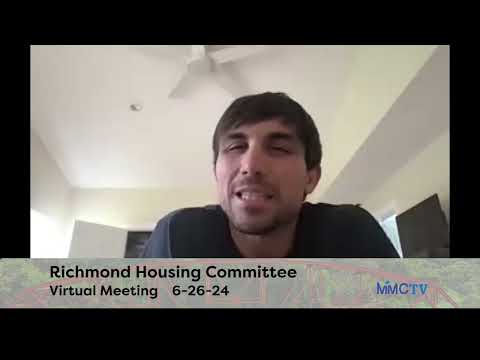
Two invited guests — Carl, chair of Hinesburg’s affordable housing committee, and developer Ben Avery — outlined practical lessons Richmond can use to increase housing production, emphasizing process clarity, partnerships and targeted incentives.
Carl described Hinesburg’s long-running committee (formed in 2006), the value of selectboard and planning-staff support, and outreach tactics such as monthly local newspaper articles, DRB participation and small revolving funds seeded by grants. He urged Richmond to link any voter ask for a housing trust to a concrete project rather than asking for a general pot of money: “we want to try to connect it to a specific project,” he said.
Ben offered a developer’s view on what makes projects feasible: simple, well-defined zoning; streamlined fee schedules; and the ability to use mixed-unit projects so market-rate units subsidize inclusionary units. He described how inclusionary zoning that requires roughly one affordable unit per ten (triggered at about 10 units) can work when projects mix unit types and partner with nonprofits for subsidy or deed-restricted for-sale models.
On financing, Ben warned that current borrowing costs reduce feasibility for many projects: “when your interest rates go from 4% to 8% … it just decimates that whole program,” he said, and recommended timing flexibility for perpetual-affordability requirements. He explained one practical enforcement approach: a one-page permitting form tied to a HUD affordability chart and a deed restriction that confirms perpetual-sale limits at the time of transfer. Rental affordability, he noted, requires annual oversight; perpetual-sale restrictions are enforced at transfer.
Both guests recommended local incentives to offset municipal fees and infrastructure costs—Ben cited an example analysis showing roughly $177,000 in municipal/state fees per unit in one project—and urged Richmond to pursue targeted fee reductions or waivers for affordable projects. They also recommended building a roster of community advocates to testify at meetings and backing outreach with neighborhood-facing communications.
Committee members thanked the guests and agreed to draft a strategy outline with smaller research groups to explore partner development, water/sewer rules, tax abatement options and a potential housing fund. The committee adjourned after setting the next meeting date.