Get Full Government Meeting Transcripts, Videos, & Alerts Forever!
Get email alerts on the Land Use Livestock topic
No spam. Unsubscribe anytime.
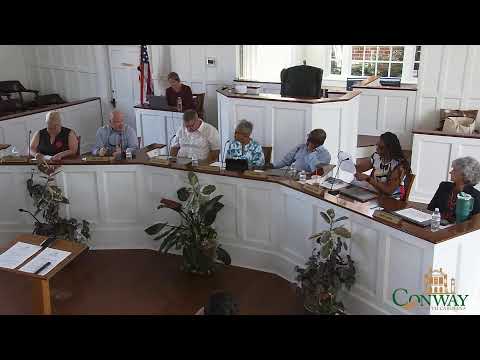
Conway council approves first reading to allow noncommercial livestock on 20‑acre parcels
Summary
The Conway City Council approved first reading of an amendment to allow noncommercial keeping of livestock and fowl on parcels of 20 acres or more with a single‑family dwelling, retaining setbacks, containment and nuisance rules; council members sought definitions and enforcement details before final reading.
The Conway City Council on June 15 approved first reading of an amendment to the city’s unified development ordinance that would allow noncommercial keeping of livestock and fowl on parcels of at least 20 acres that contain a single‑family dwelling.
Planning staff told the council the change “creates a limited exception for properties that contain at least 20 acres, contain a single family detached dwelling as the principal use,” while preserving existing standards on setbacks, containment and nuisance prevention. Miss Hux, the staff presenter, said the modification responds to situations where large parcels inside the city contain a single home but the applicable zoning currently bars livestock.
Council discussion focused on definitions and enforcement. Miss Helms asked whether chickens would be included; staff answered that fowl are included and that livestock would explicitly include animals such as horses, cows, goats, sheep and pigs. Staff also reported the amendment adds clearer language excluding exotic species (for example, deer, bison, wild boar, emus, peacocks, raptors and reptiles).
Several members pressed on enforcement and grandfathering. Mr. White asked whether existing operations would be grandfathered; staff said there is no automatic grandfathering, though legal nonconformities remain possible and would require evidence to sustain. Miss Helms and others requested staff provide typical cost comparisons and complaint response steps before final reading.
After questions and debate over setbacks, noise and nuisance enforcement, a council member moved and the body approved first reading unanimously. The ordinance reorganizes the accessory‑use section for clarity and directs staff to keep current standards for containment and nuisance response in place.
Next steps: the city will schedule a second reading (final vote), and staff indicated it will provide more detailed enforcement and fiscal impact information ahead of that meeting.