Get Full Government Meeting Transcripts, Videos, & Alerts Forever!
Get email alerts on the Housing Production topic
No spam. Unsubscribe anytime.
Public urges Eugene council to back housing production incentives; resident warns against more tax exemptions
Summary
Several residents and housing advocates urged the council to adopt proposed property tax exemption programs and a middle-income revolving loan fund to accelerate housing production; one resident cautioned against expanding tax exemptions without reportbacks on existing MUPTEs. Staff clarified MUPTE eligibility and data limitations.
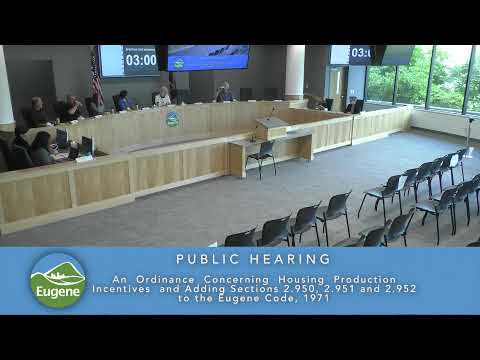
During the third public hearing on June 15, housing advocates, nonprofit leaders and residents urged the Eugene City Council to approve proposed housing production incentives and property tax exemptions aimed at accelerating construction of moderate-income housing along transit corridors and in commercial centers.
Sylvia Barry, representing the community coalition ACT NOW LANE and speaking as a nonprofit housing advocate from Ward 5, asked councilors to support the incentives, schedule a public hearing on a proposed moderate-income revolving loan fund and back projects that combine affordable and workforce housing. "Please support the housing production incentives and tax exemption programs being discussed tonight," Barry said.
Larissa Ennis (Ward 7), senior manager of developments and communications at Food for Lane County and chair of the Lane County Affordable Housing Agency, cited the ALI Court project as an example of what coordinated public investment can produce. Ennis said the city conveyed land and provided more than $3 million in development resources and fee assistance to make Ali Court — 80 units of affordable family housing co-located with an early childhood education center — feasible. "As of June 1, every unit in Ali Court is fully leased," Ennis said, urging councilors to treat incentives as necessary tools to replicate such projects.
Joe Liebersbach, a longtime Lane County resident, emphasized the human stakes and urged the council to carry forward momentum from earlier work sessions, calling the housing action "an important step" for future generations.
Hope Baker (Ward 2) said she supports incentives for affordable and lower-middle-income housing but opposed additional property tax exemptions because of the city’s budget constraints. Baker asked for reportbacks on existing Multi-Unit Property Tax Exemptions (MUPTEs) — including how many are active, how many have been extended and the resulting tax revenue impacts — saying she has not seen those evaluations. "I've never gotten a reportback," Baker said.
Councilor Groves asked staff whether there are active MUPTEs on Franklin Boulevard. Amanda De Souza, Programs Manager in Community Development, replied that student housing is not eligible for MUPTE, that projects built after 2015 have not received MUPTE, and that the city’s data cover a small number of projects built prior to 2015.
The public hearing closed after the last speaker. No vote was recorded in the transcript; next steps for council deliberation on the proposed tax exemption programs were not specified in the hearing record.