Get Full Government Meeting Transcripts, Videos, & Alerts Forever!
Get email alerts on the Hhr Local Control topic
No spam. Unsubscribe anytime.
House Minerals Committee advances bill giving cities and counties clearer authority over historic-horse-racing terminals
Summary
The committee passed Senate File 45 to clarify how cities and counties review, condition, renew and — in some cases — revoke permits for historic-horse-racing (HHR) simulcasting facilities. Witnesses debated appeals, the 100-mile rule and economic effects on live racing; the bill passed unanimously.
The House Minerals Committee voted to advance Senate File 45, a bill that clarifies local roles in permitting, conditioning, renewal and potential revocation of historic-horse-racing (HHR) and simulcasting facilities while preserving the state gaming commission's overarching authority. The committee approved the measure by roll call after extended testimony from county officials, municipal leaders and industry representatives.
Supporters said SF45 restores meaningful local control that counties and municipalities currently lack. Senator John Cole, who chaired the Senate interim work that produced the bill, told the committee the bill responds to court decisions that left local elected officials little recourse after they granted initial approvals. "At the end of the day this will give communities a local control they absolutely do not have now," Cole said, summarizing the bill's intent to create review, denial and revocation pathways alongside clear renewal procedures.
Why it mattered: The statute touches zoning, taxation, public safety and the economics of live horse racing. HHR machines have been authorized in Wyoming since 2013; proponents say HHR revenue helps finance purses and sustain live racing, while critics warn of proliferation of gaming-like terminals in small commercial venues.
Key debate and amendments: Committee members and witnesses focused on three fault lines: (1) the extent of municipal versus county authority in a statutory half-mile extraterritorial buffer, (2) whether initial denials should be judicially reviewable (two appeal options were discussed), and (3) preservation of the so-called "100-mile rule" that limits operation of nearby terminals during live race events.
- Jurisdiction in a buffer zone: County and municipal representatives explained the bill adopts a bifurcated approach: municipalities make final decisions inside their corporate limits while counties govern unincorporated areas; the other party may submit timely objections and the bill requires consideration of those objections without creating dual permitting. Jeremiah Reeman of the Wyoming County Commissioners Association said the bill's language was crafted to avoid overlapping permits and to formalize a review-and-objection process.
- Appeals and due process: The most contested issue was whether a new applicant has a right to judicial review if a local body initially denies an application. Existing operators and several witnesses favored a limited or no right of appeal on initial applications (option A), modeled in part on liquor-license law, to reduce litigation and preserve local authority. New-market entrants such as Cowboy Racing argued that denying judicial review to initial applicants would entrench incumbents and risk monopolies or duopolies; Afy Ellis, representing Cowboy Racing, said removing appeal rights could "punish the newcomer" and undercut business certainty for investors seeking to build live tracks.
- The 100-mile rule and industry incentives: Multiple witnesses urged that SF45 not repeal the 100-mile rule, an incentive that requires offsite terminals within 100 miles of a live track to either shut during live race times or negotiate a waiver that directs revenue to live purses. Cowboy Racing and other prospective operators said the rule was critical to the business case for building live tracks and that repeal should be handled separately.
Economic and operational details: Industry witnesses supplied operational numbers to illustrate market concentration and investment stakes. Witnesses said three racetracks currently hold permits with a fourth under construction in Laramie County; one operator reported millions in private investment and sought permission for hundreds of machines at multiple terminals. Witnesses also referenced disparity between "approved" terminal counts in statute versus machines presently operating at facilities.
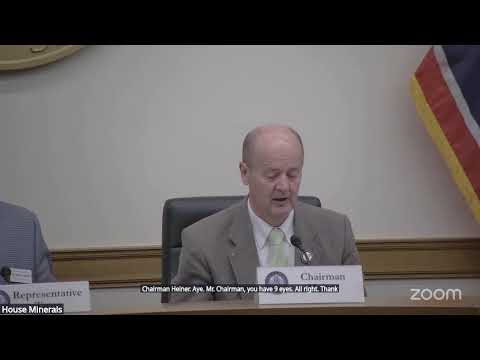
Vote and next steps: Representative Lai moved to advance SF45; Representative Knap seconded. The committee voted by roll call and recorded nine affirmative votes. "That Senate File 45 has passed unanimously," Chairman Heiner announced; the committee adjourned. Representative Steve Johnson indicated he would carry the bill on the House floor.
What remains: The transcript shows remaining disagreements over the appeals framework and the 100-mile rule. Several witnesses urged separate legislation or later amendments to address the 100-mile rule and the percentage of HHR revenue that must be dedicated to live purses. The bill as reported narrows statutory gaps but leaves contested policy choices for later floor debate and possible amendments.
Sources: Committee testimony from Senator John Cole; Representative Steve Johnson; Jeremiah Reeman (Wyoming County Commissioners Association); Mayor Matt Murdoch (Town of Pinedale, WHAM president); Afy Ellis and Shane Schultz (counsel for Cowboy Racing); Maryanne Chainer (Wyoming Downs / 307 Horse Racing); Cherylyn Kaiser (Wyoming Horse Racing LLC); public comment from Jim Jonas. The committee record shows the roll-call vote and passage of SF45.