Get Full Government Meeting Transcripts, Videos, & Alerts Forever!
Get email alerts on the State Lands Subleasing topic
No spam. Unsubscribe anytime.
Agriculture Committee approves bill allowing subleases of state grazing lands
Summary
The Agriculture Committee voted to advance Senate File 16, permitting leaseholders of state land to sublease grazing rights to other livestock owners under a monthly non‑owned livestock fee (capped relative to the animal unit month rate) and an 80% common‑ownership exception; the measure passed by roll call, seven ayes and two excused.
The Agriculture Committee voted to approve Senate File 16, a measure that would let leaseholders of state land sublease parcels for grazing to other livestock owners under a new monthly non‑owned livestock fee. Committee members approved the bill by roll call after testimony from the Office of State Lands and an industry representative.
Representative Banks, who introduced the committee bill, told members it would allow a lease of a state land parcel to be subleased for grazing and set out parameters and notification requirements. "On page three, you'll see some of those parameters; notice the presence of livestock not owned by the [lessee] shall be given to the board not more than 30 days after the arrival of those livestock," Banks said in opening remarks, summarizing the measure's mechanics and renewal provisions.
Staca Barry of the Office of State Lands and Investments testified that the office worked with the Farm Bureau and stock growers during the interim to craft the bill. "We were fortunate enough to work with both Farm Bureau and stock growers during the interim to try and find solutions that met needs for producers," Barry said, describing the proposal as a more streamlined option that "offers a different way for producers to do subleasing that's a little bit more straightforward with that non‑owned livestock fee." Barry also noted the bill includes an exception allowing two entities that share greater than 80% ownership not to require a sublease.
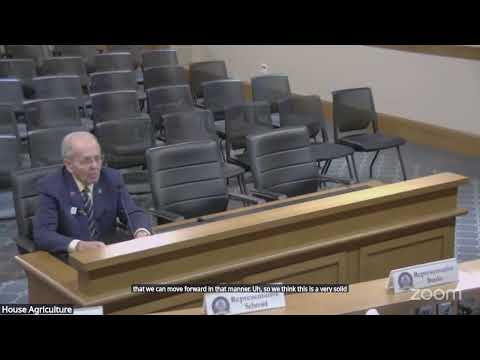
An industry witness, Mr. McGna, described operational changes in ranching and said prior rules produced instability for many producers. He urged a flat monthly fee set by the board as a defensible approach: "Trying to figure out what the right number is that's defensible and fair to everybody was an impossible challenge. That's where we felt if we could get a reasonable flat fee and the amount that fee will be at the discretion of the board commissioners when we're comfortable with that we can move forward in that manner," McGna said, arguing the change would provide more predictable rules for producers.
Representative Forstrom asked for clarification about the 80% ownership threshold and whether a lower percentage had been considered; the committee was told the percentage was suggested by industry participants during the drafting process. No further amendments were offered during committee consideration.
A motion to advance the bill was made by Representative Otman and seconded by Representative Johnson. The committee conducted a roll call vote: Representatives Banks, Davis, Forstrom, Johnson, Otman, Stro and Chairman Winter voted "aye"; Representatives Pvenza and Schmid were recorded as excused. The chair announced, "you have seven ayes, two excused," and the committee approved the measure.
The bill will proceed according to the legislative schedule for further consideration. The committee adjourned following the vote.