Get Full Government Meeting Transcripts, Videos, & Alerts Forever!
Get email alerts on the Education Budget topic
No spam. Unsubscribe anytime.
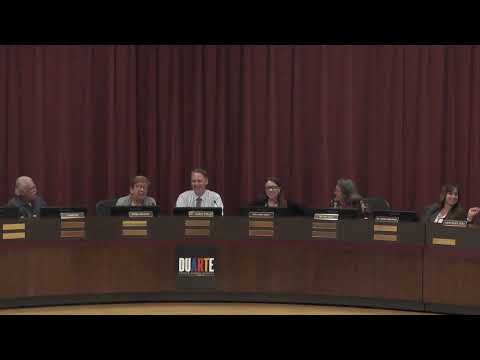
Duarte Unified presents 2026–27 LCAP and proposed budget, flags enrollment decline and reserve planning
Summary
Duarte Unified trustees heard a detailed presentation on the district—s 2026—27 Local Control and Accountability Plan and the proposed 2026—27 budget, including a 68.87% unduplicated pupil rate, multi-year enrollment declines, $1.8—m+ of budget-stabilization shifts, and plans for ADA recovery and carryover spending.
Duarte Unified School District on Monday heard a public presentation of the district—s 2026—27 Local Control and Accountability Plan (LCAP) and the proposed 2026—27 budget, with district leaders seeking to align supplemental funds to targeted interventions as enrollment continues to decline.
Dr. Carly Olsson Marasek, the district—s LCAP consultant, told trustees the LCAP is a three-year, locally driven plan that focuses district resources on five goals but directs supplemental and concentration funds primarily to three priorities: college and career readiness; safe and welcoming schools; and family and community partnerships. "The purpose of the LCAP is to get students through at the highest level," Marasek said, and she highlighted specific actions such as class-size reduction, targeted supports for English learners and summer school programming.
Why it matters: the LCAP describes how state and federal funding will be used to close achievement gaps. Marasek noted the district—s unduplicated pupil percentage was 68.87% last year, a figure that determines supplemental/concentration funding under the LCFF formula.
Superintendent Dr. Madrono followed with a budget presentation, outlining statutory timelines and the district—s approach to multi-year projections. She reviewed assumptions driving the budget: projected enrollment decline (district headcount has fallen from about 4,000 historically to roughly 2,800 today, with an anticipated loss of about 100 students over the next three years), reliance on LCFF funding sensitive to average daily attendance (ADA), and several expenditure pressures including pension obligations and employee benefits.
Madrono said staff identified roughly $1.8—m to $2.0—m in shifts and savings as part of a budget-stabilization plan, including reallocations of categorical carryovers into restricted funds and modest utility savings. She described plans to pursue revenue enhancements next year, notably an ADA recovery program that would offer students opportunities outside regular instructional hours (after-school or Saturday programming) to recuperate missed ADA and thereby recover attendance-based funding.
Trustees pressed staff on program carryovers and whether restricted funds had been left unused. One trustee asked whether the visible carryovers meant entitlements had not been spent for the students they were intended to serve; the superintendent and fiscal staff confirmed that the carryovers are restricted funds and said the district had reviewed grant deadlines to avoid returning monies. "We are not returning any money," the superintendent said, adding staff reviewed deadlines and compliance to preserve entitlements.
Board members repeatedly asked for more explicit benchmarks in the LCAP (several urged the inclusion of the "reading by third grade" benchmark) and asked staff to return with figures explaining long-term revenue projections and assumptions behind the multi-year estimates.
What's next: the board opened and closed the public hearings for the LCAP and the budget (no public speakers) and will consider formal adoption at an upcoming meeting after the district completes statutory filings and any adjustments following the state budget enactment. The superintendent said the district will return with the 45-day revisions and un-audited actuals in August and September, respectively.
Supporting details and clarifications: Marasek described blended funding strategies (using supplemental/concentration funds along with Title I/III dollars for positions such as family liaisons and counselors). The budget presentation noted estimated actual expenditures for 2025—26 and proposed allocations for 2026—27, with staff emphasizing that restricted funds must be spent in accordance with their terms.
The meeting record shows trustees commended the clarity of both presentations and asked staff to provide the specific figures and documentation requested at a future meeting.