Get Full Government Meeting Transcripts, Videos, & Alerts Forever!
Get email alerts on the Education Regionalization topic
No spam. Unsubscribe anytime.
MCPS outlines regional high‑school model, applications open in October; phased rollout begins in 2027
Summary
Montgomery County Public Schools staff described a new regional model that assigns students to home high schools but allows in‑region applications to specialized 4‑year pathways; applications open in October, acceptances announced in January, and the phased rollout for rising 9th graders begins in fall 2027.
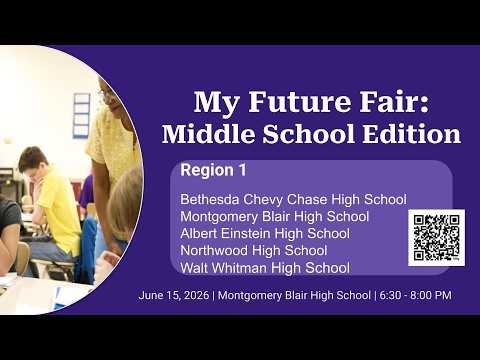
Ebony Langford Brown, a presenter for Montgomery County Public Schools, and Peter Ostrander, a district presenter, laid out the county’s new regional high‑school model and the application timeline during a Region 1 information session.
The presentation said the county will be divided into six geographic regions, each containing four or five comprehensive high schools. Students will be assigned to their home high school but may apply to specialized regional programs hosted by other schools in the same region; accepted students attend the host school full time for the school day. "Transportation will be provided," Langford Brown said, adding that bus service to regional programs will use centralized stops at schools, libraries or community centers rather than neighborhood door‑to‑door routes.
Why it matters: District staff said the change is intended to expand access to specialized programming and reduce barriers created by distance and uneven historical transportation support for magnet programs. Langford Brown noted that historically about 3,000 students applied for magnet programs and roughly 300 were placed; moving programs into regional sites, she said, should increase available seats.
How programs work: The district described three program admission types. Criteria‑based programs require minimum academic thresholds and, for arts programs, may require a portfolio or audition. Interest‑based programs are allocated by lottery. A third hybrid category (interest plus criteria) applies to offerings such as a middle college, which allows students to earn both a high‑school diploma and an associate degree while meeting Montgomery College prerequisites.
Admissions and schedule: Staff said the High School Common Application will be available through the district’s ParentVUE/Synergy portal. Finalized criteria and submission details will be published by mid‑August, the application opens in October and closes in November, and families will be notified of outcomes in January. Langford Brown said students may apply to multiple programs but can be enrolled in only one program at a time; typical out‑of‑area seats per regional program were estimated at 30–60.
Implementation timeline: The district will phase in regional programming one grade level at a time. Current 7th graders will begin the process in fall 2027 as rising 8th graders and the district expects to bring in one cohort per year, with full implementation targeted for the 2030–2031 school year.
Program design: Each regional pathway is a structured four‑year sequence with cohorting for certain courses, culminating work such as capstones or portfolios, and external validation (for example IB or industry credentials). Langford Brown listed five theme buckets that will be represented across regions: medical science/healthcare; STEM; IB/humanities and languages; leadership and public service; and visual & performing arts/design & communication. She emphasized that every comprehensive high school will continue to offer graduation requirements, advanced courses and student supports in addition to the new regional offerings.
Region 1 placements: For Region 1 specifically, Langford Brown said Bethesda‑Chevy Chase will host IB and engineering; Blair will host science/math/computer science, cybersecurity and communications; Einstein will host visual arts, music and medical/biotech programs; Whitman will host leadership/social justice and critical languages (noting Chinese as a focus); and Northwood will host theater/dance, agriculture and middle college tracks (business, general studies, engineering).
Staffing, quality and legacy structures: Ostrander said the district will use existing program curricula and trained teachers to document and expand quality across new sites, deploy school‑based and central positions to oversee program standards, and work with HR to meet staffing needs. He also announced that existing consortia (for example, some down‑county or northeast consortia) will be retired and replaced by the regional model.
What families should do next: Presenters encouraged families to attend October open houses, consult middle school counselors who have been trained on the new programs, and use the district website and QR resources to review pathway details, core experiences, course progressions and program requirements. "We will send out lots of blasts," Langford Brown said, and staff will be available for individualized Q&A after the session.
The district did not take formal votes at the event. Presenters said they will monitor application interest in early years and adjust seat allocations as needed.
Next procedural step: The district will publish final admission criteria by mid‑August; the High School Common Application opens in October and parents should use ParentVUE to submit materials. Families should expect acceptance notifications in January.