Get Full Government Meeting Transcripts, Videos, & Alerts Forever!
Get email alerts on the School Transportation topic
No spam. Unsubscribe anytime.
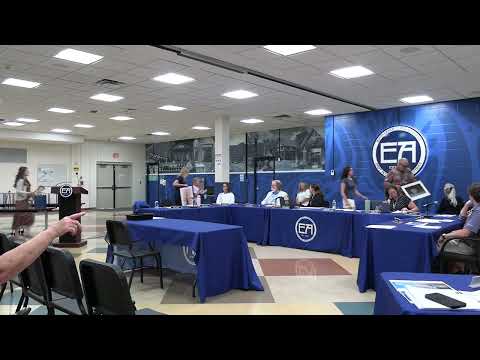
First Student tells East Aurora board one bus route can be cut after rider counts; consultant warns time windows, not seats, constrain routes
Summary
A First Student analysis presented June 3 to the East Aurora Union Free School District board said afternoon bell clustering leaves only about 40 minutes to drop middle/high school students and reach Parkdale, limiting consolidation options; targeted rider counts enabled the elimination of one route, with estimated annual savings of about $86,000.
Colton Graham, director of routing for First Student, told the East Aurora Union Free School District board on June 3 that district bus routing is constrained by afternoon bell times rather than empty seats, and that targeted ridership counts allowed the company to consolidate at least one run for the coming school year.
Graham said an "efficient bus route will either consume all of its available seat or all of its available time," and described a tight PM window: buses must drop high school and middle school students and arrive at Parkdale within roughly 40 minutes. After counting riders on 16 secondary runs, First Student identified low-ridership runs and consolidated one middle/high school route, which the company and district staff recommended eliminating for the upcoming year.
The consultant and district staff estimated the direct savings from removing that one route at about $86,000 annually. Board members asked follow-up questions about contract flexibility and safety. A district representative confirmed the contract "allows for additions and subtractions at the district's prerogative," and First Student said it would rely on other buses or alternate drivers if an emergency evacuation required extra capacity.
Graham recommended two steps for further savings: register secondary riders by name so routing can be demand-driven rather than routing every eligible stop, and consider small bell-time adjustments (he suggested roughly a three- to 15-minute additional spread between tiers) to gain enough PM time to consolidate an additional run. Graham said registering riders would clarify that roughly 5020to 53% of eligible secondary students actually ride on a regular basis, and that visible ridership data could eliminate whole roads from routes.
Board members pressed on trade-offs: consolidation can lengthen some students' ride times (Graham said he used a 50-minute maximum as a guideline and some consolidated runs increase a given student's time by a few minutes), and the district's reimbursement and safety obligations must be weighed. Finance questions also noted that an $86,000 gross savings is reduced by the district's transportation reimbursement rate (discussed later in the meeting at about 57%), lowering net general-fund impact.
Next steps recorded in the presentation included implementing the immediate consolidation (eliminating bus 114/914 as tested in the routing exercise) for 2026-27 and discussing whether the board wants to pursue bell-time adjustments and a secondary-rider registration system before finalizing routes this summer. First Student said it would provide more detailed routing options after the board decided whether to adjust bell times or pursue rider registration.