Get Full Government Meeting Transcripts, Videos, & Alerts Forever!
Get email alerts on the Signage topic
No spam. Unsubscribe anytime.
HLRB approves retroactive sign at 2408 Columbia Pike, requires revision and reinstallation
Summary
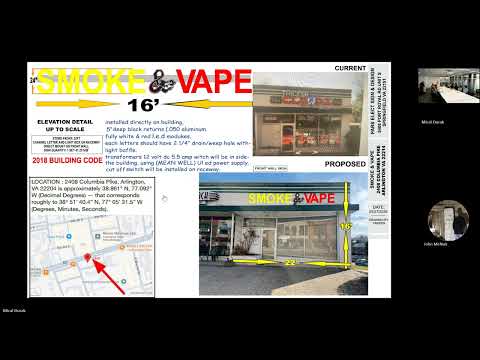
The Historic Landmarks Review Board approved COA26-05 on June 15, 2026, allowing a retroactive 21-inch-by-16-foot sign at 2408 Columbia Pike on the condition that the current, incompatible sign be removed, revised to the approved layout and reinstalled under the buildings banding; the board voted to approve the staff-recommended COA.
The Historic Landmarks Review Board voted June 15 to approve a retroactive Certificate of Appropriateness (COA26-05) for a commercial sign at 2408 Columbia Pike, requiring the applicant to remove the currently installed sign, revise it according to the approved plans and reinstall it beneath the buildings decorative banding.
Staff described the building as a 1951 commercial property designated for facade preservation under the Columbia Pike form-based code and said the applicant had been offered three design options by the Design Review Committee (DRC). The applicant selected an under-band option limited to the text "Smoke and Vape." Staff recommended approval of the application as submitted, noting the proposed materials and overall design conform with the Secretary of the Interiors Standards for Rehabilitation (Standard #10) and with other signage along the corridor. "HPP staff recommended approval of the application as submitted," a staff member told the board.
Sign contractor Mr. Fazion, who identified himself during the hearing, explained the installation path: he said an installer believed that an approval showing in another department meant the project could proceed, so the sign was installed before HLRB review. He said the original proposal used larger letters but the applicant later decided to reuse existing 21-inch letters and relocate one raceway. "If you tell me go and remove it, I'll remove it tomorrow morning," Mr. Fazion said, adding he would submit a revised 21-inch layout for the stamped sign permit.
A DRC representative explained that the horizontal banding is a defining architectural element of Columbia Pike facades and that locating the sign under the banding preserves the buildings character. Board members asked staff to ensure the stamped plans submitted with the sign permit reflect the 21-inch-by-16-foot layout and centered placement with a small clearance under the banding for visibility.
Board member motioned to approve COA26-05 to allow a retroactive 21-inch-by-16-foot sign at 2408 Columbia Pike, to be installed under the upper bands of the building as shown in the submitted plans, with the condition that the applicant remove the current sign, revise it as shown on the submitted plans, and reinstall it. The motion was seconded and called to roll; the board recorded affirmative votes and the motion passed.
The decision requires the applicant to submit stamped plans with the sign permit that match the approved stamped layout. Staff said the HLRBs stamping will lock the permitted dimensions; any enlargement beyond what HLRB stamps would require returning to the board. The board also asked staff to follow up on an adjacent sign and any additional compliance issues.
The HLRBs action is procedural: it approves the sign design under the COA authority but requires the applicant to secure a sign permit and submit the stamped layout before final installation. The applicant has agreed to submit the revised layout and to remove or alter the existing installation to conform with the HLRB decision.
What happens next: staff will expect a stamped sign layout at the 21-inch-by-16-foot dimension to accompany the sign permit; if the applicant alters the dimensions beyond what the HLRB stamps, the applicant must return to the board for approval.