Get Full Government Meeting Transcripts, Videos, & Alerts Forever!
Get email alerts on the Student Privacy And Screens topic
No spam. Unsubscribe anytime.
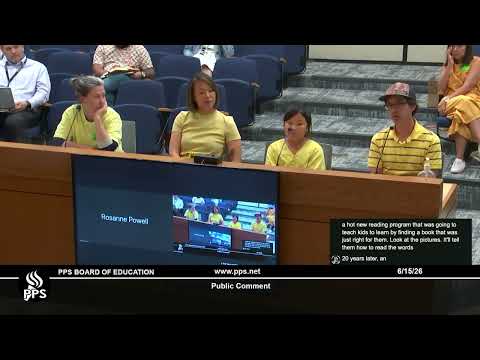
Parents and students urge limits on classroom screens and generative AI as Portland schools craft student-privacy policy
Summary
Public commenters and the district debated proposed student-privacy and "safe schools" policy required by state law, with parents and a student urging limits on screen-based instruction and raising concerns about vendor data collection (notably an Amira pilot). Staff said the draft aligns with SB 1538 and HB 479 and that legal will review contracts; no formal vote was taken.
Portland Public Schools policy committee on June 15 heard repeated calls from parents and a fourth-grade student to reduce screen-dependent instruction and to curb student access to generative artificial intelligence on district devices, while staff said a draft student-privacy policy aligns with recent Oregon legislation and will be crosschecked against existing contracts.
"This is not feedback, and this is not learning," parent Holly Hoffamp told the committee, describing classroom experiences where students received AI-generated corrections instead of teacher feedback and where district devices prompted AI homework helpers. She said an early-grade pilot of the reading chatbot Amira had been deployed with limited parental notice and that district contracts she reviewed seemed to include sensitive fields. "As you draft your policies for screens in schools, please disable student access to all generative AI tools, websites, search engines, and apps on school-issued devices," she said.
The committee was also addressed by fourth-grader Elise Huang, who said she learned more from in-person instruction than from the district's I-Ready digital program. "I need a real person in my face telling me how to do something," Huang said, describing difficulty answering basic math questions until she returned to more teacher-led lessons.
Why it matters: House Bill 479 requires districts to adopt a policy confirming how they will protect student safety and access; staff said the district must complete that work by Sept. 30, 2026. Parents and educators at the meeting urged the committee to ensure the policy provides robust data protections and limits inappropriate classroom screen use, especially for young students.
Staff response and limits of what was resolved: Policy drafter Will Fernandez and other staff said the draft is aligned with Senate Bill 1538 and House Bill 479 and relies on a toolkit already developed to operationalize the policy. Patty Sullivan and other staff noted the draft policy includes a section on protecting student and family information and that legal counsel would be consulted if law enforcement or other parties request records.
When asked directly about the Amira pilot and whether the vendor contract required collection of fields such as place of birth, race/ethnicity, IEP status or English-language-learner status, staff said they could not answer detailed contract questions during the meeting and agreed to follow up. "I can't speak to Amira or that contract," one staff member said, adding legal review and crosswalking to related policies would be part of implementation.
On screen-time guidance, district presenters emphasized research distinguishing active, instructional screen use from passive screen time. Staff said I-Ready's digital component, when used per publisher guidance, is intended for roughly 15 to 20 minutes (sometimes described as up to two short uses per week) but acknowledged testimony that some students spend far longer in practice. Technology staff said district systems can measure device usage and apply filters but currently lack automated, real-time alerts to warn that an individual student is exceeding recommended use.
Next steps: The committee did not take formal action on the draft policy June 15. Members signaled support for developing two separate documents (a screens policy and an AI policy), asked staff to provide detailed crosswalks with existing enrollment/attendance/privacy policies (including McKinney-Vento protections and special-education exceptions), and requested follow-up on vendor contracts and district monitoring capability before moving the policy forward to the full board.
The meeting record shows the district will continue community engagement and return with more detailed data and recommended policy language ahead of the Sept. 30, 2026 legislative deadline.