Get Full Government Meeting Transcripts, Videos, & Alerts Forever!
Get email alerts on the Safe Routes To School topic
No spam. Unsubscribe anytime.
Vancouver and regional partners brief BPAC on Safe Routes to School, bike education reaches hundreds of students
Summary
City of Vancouver staff and regional partners described the newly launched Safe Routes to School program and the Let's Go bike education curriculum, noting adaptive bikes, grant-funded support from the Climate Commitment Act, and early reach statistics (about 350 students learned to ride in three years).
City of Vancouver planners and regional partners presented the city’s new Safe Routes to School program and a regionally coordinated bike-education effort during the Bicycle and Pedestrian Advisory Committee meeting.
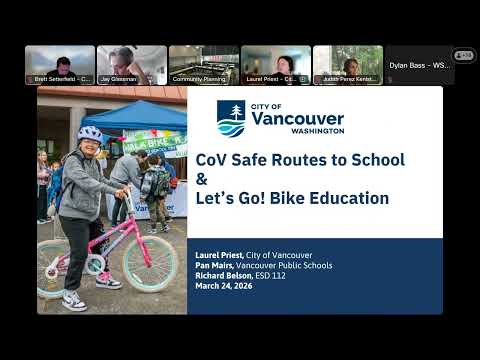
Laura Priest, a transportation planner with the City of Vancouver, said the Safe Routes to School program — launched in winter 2025 — aims to make walking, biking and rolling to school safer and more attractive through the “six E’s” of engagement, equity, encouragement, engineering, education and evaluation. "The primary goal of the program is to get more students walking, biking, and rolling to school through education, encouragement, and infrastructure," Priest said.
Education and adaptive equipment: Pan Mars, a Vancouver public schools teacher who manages the Let's Go bike education program, described the curriculum as a PE-unit for third through eighth graders that includes adaptive bikes, striders and hand-cycles so all students can participate. "Around 350 students in the last three years have learned how to ride a bike for the first time," Mars said, citing the Vancouver run of the program.
Program reach and delivery: Richard Bellson, with Educational Service District 112, said his role is to expand the program into smaller and mid-size districts, helping PE teachers adapt the curriculum to local conditions. He said the program aims for broad reach statewide and is seeking to grow into districts such as Ridgefield and Battleground.
Funding and partners: Presenters said the Let's Go program and related activities are funded in part by the Climate Commitment Act and administered through Cascade Bicycle Club; the city is also pursuing state Safe Routes grants (applications were submitted March 6). City staff said a small city budget allocation covers staff time to lead the program while additional grants fund direct implementation in schools.
Evaluation and public-health ties: Committee members asked about performance measures; presenters said they plan to track mode-share tallies (how students report getting to school), before-and-after vehicle speeds for infrastructure projects, and school-level participation counts. The presenters also said they meet with Clark County public health and Safe Kids partners on helmet-fitting and outreach.
Operational items and community projects: Speakers highlighted pilot activities including a bike bus at Hall Elementary that had about a dozen students and adult volunteers, and a planned summer transportation-safety event at the Heights Bike Garden. Presenters encouraged BPAC members to volunteer for outreach and to help recruit student BPAC participants.
Questions and policy concerns: Committee members raised concerns about e-bike classifications and safety for young riders, the adequacy of bicycle parking at schools and the county’s role in supporting programs outside city boundaries. Presenters said the curriculum and outreach materials are evolving to address e-bikes and that the city coordinates with county staff for schools that fall outside city limits but that county staff currently have limited capacity to provide hands-on program support.
Next steps: Presenters said grant applications remain an important funding path for school implementation in 2026–27 and invited BPAC to help connect schools and volunteer resources to expand the program.