Get Full Government Meeting Transcripts, Videos, & Alerts Forever!
Get email alerts on the District Budget topic
No spam. Unsubscribe anytime.
Superintendent warns of mounting budget gap; board scales back high school renovation
Summary
Superintendent Dr. Johnson told the Wallingford-Swarthmore School Board the district faces a growing structural gap that could draw down fund balance if unchecked; the board approved a reduced-scope high school renovation and discussed attrition, bargaining, and other cost levers.
Superintendent Dr. Johnson told the Wallingford-Swarthmore School Board on June 15 that the district's revenue projections for the coming year are about $108 million while expenditures run above $112 million, creating a projected shortfall that the administration expects to address in part by using fund balance.
"We are projecting to use about $560,000 of our fund balance for fiscal year 27," Dr. Johnson said, adding that without changes that figure could grow to about $3.56 million in 2027–28, which would consume roughly 31% of the district's fund balance. She highlighted a $1 million increase in prescription drug costs in one recent year and projected another $1.8 million rise in medical/prescription costs for FY28 as a key pressure on the operating budget.
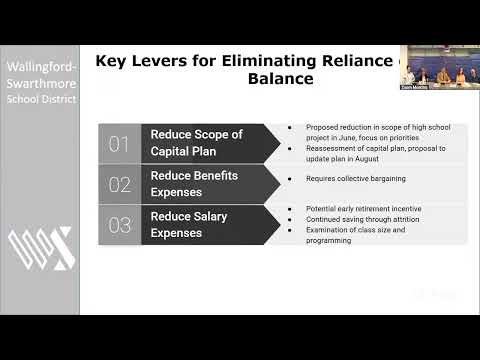
Why it matters: the district's fund balance is intended for unpredictable "rainy day" expenses, Dr. Johnson said, and sustained use of that reserve for operations would be unsustainable. The superintendent presented three main cost drivers—salaries and benefits (roughly $47–48 million of total expenditures), the capital plan, and rising benefit costs—and proposed three levers the district could use to slow fund-balance depletion: reducing the high-school renovation scope, pursuing attrition and voluntary early-retirement incentives rather than layoffs where feasible, and negotiating benefit changes that would require collective bargaining.
Board action and fiscal trade-offs: the board voted to approve a reduced-scope high-school renovation that prioritizes making the building "warm, safe, and dry," replacing modular classrooms, and focusing on high-priority instructional spaces such as science labs. Board members said the decision was difficult but necessary given staffing and operating pressures. One member urged residents to review the finance committee discussion for a deeper explanation of trade-offs.
Votes at a glance: the board recorded unanimous roll-call approvals (9–0) on consent personnel items, the finance and facilities consent bundle (items A–S), and the scope-reduction motion for the high school renovation. The renovation motion was moved by Mr. Miller and seconded as announced on the floor; the roll-call tally was recorded as nine in favor.
Public reaction and next steps: several public speakers raised concerns about staffing reductions and class-size increases tied to the budget. Parent Jamie Lemi said MPE fourth- and fifth-grade classes will drop from four teachers to three by attrition, increasing class sizes to an expected 24–27 students and leaving families seeking clearer communication and plans for supports.
Financial details and clarifications: the superintendent presented the administration's revenue and expenditure estimates and the capital plan assumptions in detail; she said the district had engaged a third-party budget analyst to vet projections. On personnel costs, Dr. Johnson noted that while layoffs are a last resort, the administration is examining attrition, possible early-retirement incentives, and collective-bargaining discussions about benefit changes.
What happens next: the administration plans to return in August with an updated capital-plan assessment and to continue dialogue with union leadership about benefits and staffing options. The board directed the administration to continue exploring options that minimize layoffs while addressing the projected gap.