Get Full Government Meeting Transcripts, Videos, & Alerts Forever!
Get email alerts on the Short Term Rentals topic
No spam. Unsubscribe anytime.
Port Hueneme council backs neighbor-notification approach for short-term rental rules
Summary
Council directed staff to return with a revised short-term rental ordinance that uses mailed neighbor notification rather than exterior signage, adds enforcement fines aligned with state limits and includes a one-year review; staff will return for a public hearing and coastal review.
The Port Hueneme City Council on June 15 directed staff to revise a draft short-term rental (STR) ordinance and return with a formal measure that uses neighbor mailed-notification rather than posted exterior signs.
Council and staff described the draft as a package of measures that would require annual permits and business licenses for STR operators, establish occupancy, parking and quiet-hour rules, require a nuisance-response plan and a 24-hour local contact, and cap city permits at roughly 10% in areas subject to Coastal Commission review. After public comment, the council coalesced around Option B — a yearly requirement that hosts notify neighbors within a set radius and provide a 24-hour contact — as the primary method to ensure nearby residents can reach an operator without putting host contact details on exterior signs.
Why it matters: council members said the rules are aimed at public safety and preserving neighborhood character while allowing lawful home‑sharing. Staff noted the city has limited enforcement resources and that the draft is designed to target recurring nuisance behavior rather than incidental visitors.
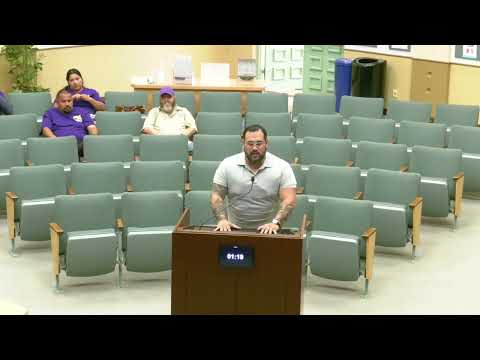
What was said: Patricia Le Pen, representing a citizen group, urged the council to require platform hosts to provide data to the city and pointed to recently passed legislation as a path to better enforcement. In public comment, Paul Quigley, a homeowner active on the issue, supported the council moving to Option B, saying the neighborhood-notification approach balances safety and privacy: “the recommended approach would be option B,” he said.
Council direction and next steps: Council asked staff to return with a formal ordinance that (1) adopts the neighbor-notification approach, (2) proposes STR-specific penalties consistent with state law (staff noted examples such as first-offense fines used elsewhere, including figures up to the state ceiling where applicable), (3) examines language limiting multiple‑owner corporate entities as permitted by legal constraints, and (4) includes a mandatory review one year after implementation. Staff estimated the Coastal Commission review and the formal public hearing cycle could take roughly three to five months, then recommended a one‑year post‑implementation review to evaluate enforcement and outcomes.
Enforcement and revenue: staff and the city attorney said the program is not expected to be a major revenue source; the city would rely on administrative enforcement and partner data if platforms are required to report listings. Any fine structure in the ordinance will be written to match state limits and administrative enforcement practice.
The council did not adopt the ordinance on June 15; staff will return with the revised text and a proposed penalty schedule for public hearing and Coastal Commission submittal.