Get Full Government Meeting Transcripts, Videos, & Alerts Forever!
Get email alerts on the Budget Overview topic
No spam. Unsubscribe anytime.
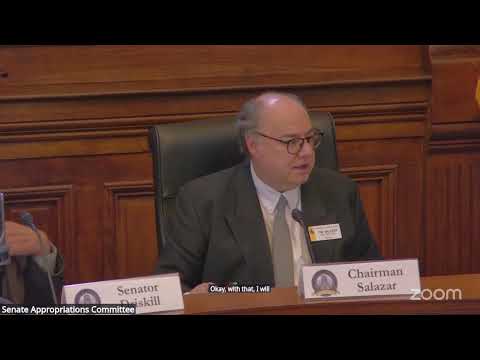
Senate Appropriations committee reviews competing budget plans; meeting was educational, no votes
Summary
Senate staff presented a line-by-line comparison of the governor, JAC, House and Senate positions on HP00001, highlighting differences in appropriations, reserve balances and several cross-file conflicts; committee received the briefing—no votes were taken.
Don Richards, LSO budget fiscal administrator, told the Senate Appropriations Committee that the one-page packet compares the governor, JAC, House and Senate positions for the HP00001 general government appropriation. "JAC cut $319 million in general funds, $480 million in total," he said, and described the House as roughly a third of the way between JAC and the governor on total changes.
Richards said the Senate position spends "about $53 million more than the governor did in general funds" but is close to the governor's total in net savings, and he directed members to the worksheet column showing House–Senate differences (Column J) for the most important negotiation points. He emphasized the document reflects appropriations and reversions (spending intent) and does not include revenue or transfers.
Staff noted a late insertion to the budget process: an appropriations action for higher-education research (Senate File 104) for about $51.2 million occurred after initial budget work, leaving both chambers out of balance relative to earlier reserve calculations and contributing to a gap members must reconcile. Richards also explained that apparent declines in the Legislative Stabilization Reserve (LSR) reflect a mix of transfers and accounting choices, and that some declines were shifted into the permanent Wyoming mineral trust fund reserve account (PMTF).
Committee members asked whether the state was deficit spending. Richards replied revenues are sufficient to cover the current appropriations and that the numbers can be explained by funding-source choices and a few large items, including compensation decisions and restorations for the University of Wyoming and the Wyoming Business Council.
The session was explicitly educational and designed to prepare members to brief colleagues; the chair and staff said joint conference mechanics will allow each side to move to adopt, delete, or delete and further amend specific amendment language. The committee did not take votes at this meeting and will continue appropriation work in upcoming sessions.