Get Full Government Meeting Transcripts, Videos, & Alerts Forever!
Get email alerts on the Municipal Court topic
No spam. Unsubscribe anytime.
Grants Pass council directs staff to return municipal court cost options and votes to seek changes to SB48
Summary
After a feasibility presentation, Grants Pass council voted June 15 to ask staff for detailed cost estimates comparing a violations‑only municipal court and one that includes misdemeanors (including jail‑bed costs), and it also voted to draft a resolution seeking repeal or reform of Senate Bill 48.
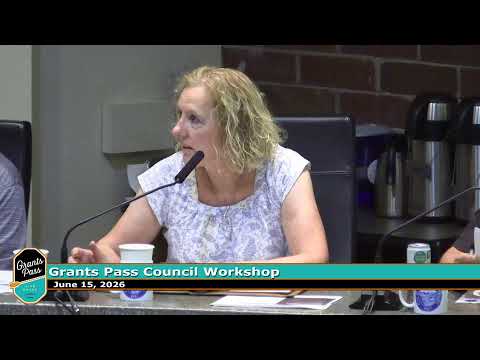
At a June 15 workshop, city staff presented a municipal court implementation feasibility study and recommended the city pursue a violations‑only municipal court with options to expand to misdemeanors later. "Implementation of a municipal court as recommended would support council's goals of public safety by modifying the municipal compliance protocols," presenter Stephanie said, outlining operational options and tradeoffs.
The presenter told council Grants Pass currently routes roughly 5,200 traffic and violations cases through the circuit court each year and that approximately 375 property misdemeanors and 120 DUIs appear in circuit court data for 2023–2025. Based on recent circuit court allocations and current case loads, staff estimated potential gross annual fine revenue of roughly $600,000 and said a municipal court would likely retain about $300,000 under existing allocation practices; the presenter emphasized that the city's portion could be used to support court operations but that general‑fund subsidization would likely be required for startup and ongoing costs.
Staff listed likely startup and operating needs for a violations‑only court: a part‑time contracted judge, a full‑time court supervisor, at least one finance FTE to handle increased payment processing, court records management software, recording/transcription equipment, training and membership costs, and other office needs. Using Medford as a comparator, Stephanie cited a Medford full‑time contracted judge contract of about $170,000 a year, court supervisor salary ranges of roughly $80,000–$102,000 (plus benefits), and clerk ranges around $51,000–$72,000. She warned that including misdemeanors would add legal costs for defense attorneys, prosecution, jail bed contracts and possibly more staff.
Chief Hensman (boots‑on‑the‑ground policing) urged council that an exclusion‑zone ordinance would provide officers another tool to remove repeat offenders from trouble spots, saying an "exclusion zone would be incredibly beneficial." Several council members said they favored starting with violations and building to misdemeanors after the court workflow and funding were proven; others urged a broader start that includes misdemeanors to address repeat nuisance and public‑safety concerns.
After discussion, Councilmember Joel moved and Councilmember Seth seconded a direction for staff to return to council with detailed implementation proposals and budget estimates comparing a violation‑only municipal court and a municipal court that handles misdemeanors, including costs for jail beds, defense counsel contracts and staffing. The motion passed on a roll call vote with the council recorded as: Joel (yes), Kathleen (yes), Seth (yes), Rob (yes), Victoria (yes), Eric (yes), Indra (yes).
On a separate item, Councilmember Victoria moved and Councilmember Kathleen seconded that staff draft a resolution urging repeal or reform of Senate Bill 48, the state statute governing pretrial release criteria in Oregon. The motion passed by majority with Rob voting no; staff said they would draft resolution language reflecting council discussion and coordinate with the city's legislative advocate.
Staff also agreed to bring an ordinance and supporting materials about exclusion zones forward sooner than previously scheduled; council and staff agreed to target a July 1 business meeting for formal consideration and asked staff to prepare ordinance language for that agenda.
Next steps: staff will prepare detailed municipal court implementation and budget proposals for both the violations‑only and misdemeanor options (including jail‑bed contracting plans), draft a resolution on SB48 for council review, and return an exclusion‑zone ordinance for the July 1 meeting.
No final policy votes on court structure or exclusion zones were taken that day; the council's direction was to seek more detailed cost and implementation information before deciding.