Get Full Government Meeting Transcripts, Videos, & Alerts Forever!
Get email alerts on the Land Use Solar topic
No spam. Unsubscribe anytime.
Presque Isle council tables Chapter 16 rewrite after sharp debate over 1,200-foot solar setback
Summary
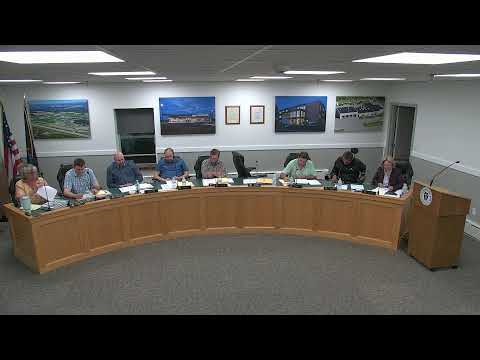
The Presque Isle City Council voted unanimously to table proposed Chapter 16 land-use revisions and asked the planning board for evidence behind a proposed 1,200-foot setback and extensive buffering standards for large solar facilities.
The Presque Isle City Council voted unanimously on Wednesday to table proposed revisions to Chapter 16 of the city’s land-use and development code after councilors questioned a proposed 1,200-foot setback for large solar installations and costly buffering requirements.
Deputy of Economic and Innovation (speaking at the meeting) told the council the draft would require a “solar electric generation facility” to be 1,200 feet from any residence and from a paved roadway, with exceptions only when the owner or lessee’s dwelling is on the same parcel. The draft also would require a 40-foot-wide buffer containing four staggered rows of evergreen plantings, a minimum six-foot initial planting height and a 95% survival rate maintained for the life of the project.
Why it matters: Councilors said the combined footprint of the setback and the four-row buffer risks eliminating most available local sites and adding tens of thousands of dollars in upfront costs, undermining the city’s ability to attract utility-scale local generation. Several members asked for studies or planning-board rationale before adopting a rule with such far-reaching siting consequences.
During more than an hour of discussion, councilors and staff debated technical details: how the draft distinguishes roof-mounted residential systems from ground-mounted commercial fields; who would maintain the buffers (staff said property owners are responsible and the code allows notices of violation and court-enforced fines); and whether the plan’s decommissioning financial assurances are sufficient (projects over three acres would be required to provide independent decommissioning reports and periodic updates to ensure financial assurance equals true decommissioning cost).
Deputy of Economic and Innovation said buffering revisions grew from repeated complaints about visibility of arrays and noted waivers could be granted if existing vegetation provides screening. “We heard a lot of complaints about buffering and people being able to see them,” the deputy said.
Several councilors asked for clearer justification for the 1,200-foot figure and examples showing where arrays could still be sited under the draft. One councilor noted large setbacks used in other jurisdictions but said the city needs the planning board’s reasoning and any supporting studies to evaluate local impacts.
Result: Councilor Craig moved to table the Chapter 16 revisions to give the planning board one month to provide documentation and rationale for the 1,200-foot setback; Hank seconded the motion and it passed by voice vote, recorded as 7-0. The council directed staff to return the draft with the planning board’s written justification and example siting scenarios.
What’s next: The council will reconsider the revisions after it receives the planning board’s documentation, likely at the next regular meeting or the October docket if scheduling requires. The pause gives staff and councilors time to weigh visual-impact mitigation against feasibility and farmland/land-use implications.
Ending: The motion to table was unanimous; councilors asked staff to bring concrete technical notes and studies to support any setback or buffer standard before the council votes on the code change.