Get Full Government Meeting Transcripts, Videos, & Alerts Forever!
Get email alerts on the Central Kitchen topic
No spam. Unsubscribe anytime.
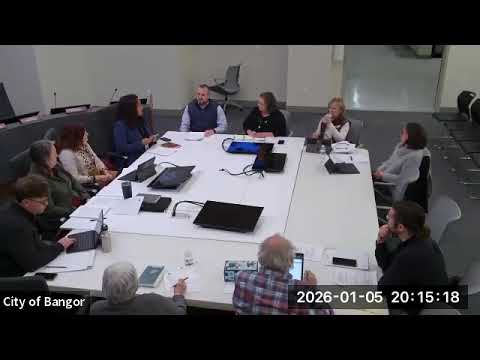
Business and Economic Development Committee delays Bangor Central Kitchen decision, asks staff for updated financials
Summary
The committee postponed a vote on the proposed Bangor Central Kitchen, asking staff to return in two weeks with updated cost, bonding and operating analyses after questions about funding, equipment choices and demand.
Councilor Leonard opened Tuesday’s Business and Economic Development Committee meeting by asking staff to present an update on the Bangor Central Kitchen project. Ann Craig, director of community economic development, said the project began at staff level in 2017 and is now proceeding on two parallel tracks: negotiating with a construction manager and onboarding an operations consultant to build governance and financial models.
Craig told the committee the city has secured $1.5 million in congressional spending and $500,000 from the Northern Border Regional Commission for the project. She said the city has so far spent about $500,000 on architectural work and earlier abatement and building assessment costs, and that the project team is considering bonding to cover remaining costs. "We've received a congressional spending amount of 1.5 million as well as $500,000 from the Northern Border Commission," Craig said.
Brad, an economic development staff member who framed the project within the region’s food-business ecosystem, described the facility as a commercial-kitchen incubator for startups, small food businesses and restauranteurs and said it is designed to complement a YMCA community kitchen and a university food-innovation lab. "The purpose of our Bangor Central Kitchen is a commercial kitchen incubator for food entrepreneurs," Brad said.
Staff described the project as rightsized at roughly 18,000 square feet and noted plans for about 7,000 square feet of temperature-regulated cold storage that could produce revenue. They also cited a 2022 market feasibility study and four USDA case studies demonstrating both the risks for businesses without incubator access and examples of entrepreneurs who credit incubator support with enabling their growth.
Councilors pressed staff for more financial detail. Questions focused on updated operating-loss projections (an earlier study referenced a roughly $200,000 annual loss in the first five years but did not include bonding costs), the expected cost and term of any bond, the operations consultant fee (staff estimated roughly $24,000), and whether the school department or other institutional partners might use the facility. Staff said they would rerun financial models once the operations consultant completes updated modeling and when construction estimates are clearer.
Councilors also debated equipment choices after one raised concerns about specifying electric induction appliances for commercial users, noting professional kitchens and renting users may prefer gas. Staff said equipment specifics remain under negotiation with the construction manager and were not fixed.
Multiple councilors raised broader concerns about timing and accountability: several asked what would happen to grant funding if the project were delayed or cancelled and whether returning or not using grants would harm the city’s credibility with funders. Staff cautioned that redirecting or returning grant funds could be difficult because many grants are restricted to specific uses.
After discussion, a councilor moved to postpone the item to the next Business and Economic Development Committee meeting so staff can supply additional data; another councilor seconded the motion. A roll-call vote recorded Counselor Malik yes, Council Carson yes, Counselor Foon no, Counselor Fish yes and Chair Leonard no; the motion to postpone carried 3–2.
The committee asked staff to provide updated national statistics on incubator success rates, a clearer accounting of bonding costs and terms, refined operating-loss projections that include bond costs, engagement status with the school department, and a summary of the businesses that have expressed interest. The committee expects staff to return with those answers at the next scheduled BED meeting in two weeks.