Get Full Government Meeting Transcripts, Videos, & Alerts Forever!
Get email alerts on the Frog Pond East topic
No spam. Unsubscribe anytime.
Developer team urges code tweaks to make Frog Pond East financially feasible
Summary
A land‑use team for West Hills asked Wilsonville council to consider clarifying housing‑diversity and open‑space rules in the Frog Pond East code so single‑family development can proceed while retaining diversity goals; council asked staff for more data and follow up.
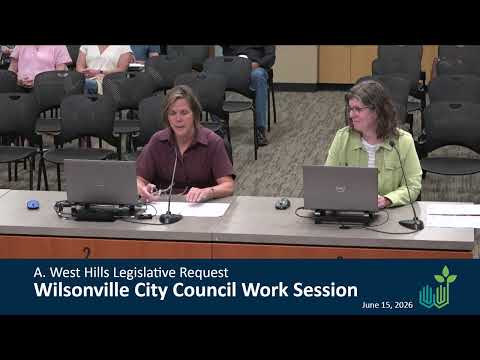
Christy White, a land‑use attorney working with West Hills, told the council that the Frog Pond East code—adopted in December 2022—measures housing diversity by land area, a method she said discourages single‑family detached homes and makes site plans financially infeasible for developers.
White said counting diversity by unit type rather than land area would better match market demand while preserving a variety of housing types. "If the goal here is that you have a bunch of different housing types, you don't lose that housing diversity. You're just counting it by unit type instead of land area," she told the council during the June 15 work session.
Why it matters: White and her team said Frog Pond East carries large infrastructure obligations—about $13 million in parks system development charges (SDCs), a three‑acre public park to be built and initially maintained by the developer/HOA, expensive roundabout and transportation improvements, and unresolved off‑site stormwater obligations—that compound the effect of the code's diversity rule. Their economic modeling (Johnson Economics) suggested low absorption rates for middle‑housing product types and showed different unit yields depending on whether diversity is counted by land area or by units.
Council response and next steps: Multiple councilors asked for the market analysis and hard data before changing policy. White said the analysis had been prepared for an application but that West Hills could generalize it for council review. Council President Barry and other members thanked presenters and directed staff to coordinate with the West Hills team to explore potential minor code amendments and additional modeling. City attorney and staff confirmed they had sufficient direction to follow up with the developer team.
What was not decided: Council did not adopt any code change at the meeting. Instead, staff will work with West Hills to prepare additional information and options for future council consideration. The presentation raised three discrete topics—housing‑diversity measurement, open‑space calculations tied to BPA easements, and SDC/transportation cost allocation—that staff said would benefit from further study.
Ending note: West Hills framed its request as an implementation refinement, not a repeal of the city's housing‑diversity objectives. Council signaled interest in seeing data and alternatives before any ordinance is drafted.