Get Full Government Meeting Transcripts, Videos, & Alerts Forever!
Get email alerts on the Budget Overview topic
No spam. Unsubscribe anytime.
RSU 03 adopts roughly $23.62 million budget; voters pass additional-local ballot 76–21
Summary
RSU 03/MSAD 03 voters approved a proposed FY27 budget of about $23.62 million and agreed to apply $2.1 million of carryover to reduce local taxes; the key additional‑local funding article (Article 14) passed by written ballot 76–21. The administration said $4.4 million in carryover — much of it ESSER COVID relief — remains as a buffer and that $600,000 is proposed for capital reserves.
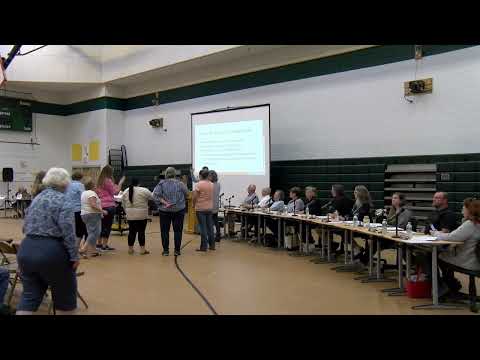
The RSU 03/MSAD 03 Board of Directors presented and voters approved a proposed fiscal 2027 budget of about $23.62 million at a public budget meeting May 28, with the board and administration emphasizing the use of carryover funds to limit the local tax increase.
Board chair Glenn Couturer opened the meeting and explained the district is carrying an unassigned balance of roughly $4.4 million. "This fund is, and I quote, COVID relief to help school districts recover from the pandemic and support student learning," Couturer said, describing roughly $7.3 million in ESSER funds received from 2020–2024 and other factors that contributed to the carryover.
Superintendent Lisa Rue described the budget development process and the administration’s plan to apply $2.1 million of carryover to the FY27 budget while moving $600,000 into a capital reserve to address upcoming facility needs. "We were able to apply $2 million from carryover, which helped offset the taxes for this current year," Rue said, summarizing how the district has used unspent balances to smooth local tax impacts.
The administration reported a proposed total budget near $23.62 million, an overall increase of about $640,700 (roughly 2.8 percent). They listed major revenue components: a state subsidy of approximately $9.74 million, a required local contribution near $6 million, and other revenue sources including tuition and fees. The superintendent also highlighted student outcomes — a projected graduation rate near 91 percent and a number of individual student awards — to frame budget priorities.
Public members asked for more granular figures, including per‑student local impacts and how carryover projections were calculated. A resident, Tammy Brass of Brooks, asked, "how much per student ... would we be paying per student?" Administrators said they could produce town‑level figures after the meeting.
Votes at a glance: the moderator read Articles 1–25 in sequence; most finance and program articles (Articles 1–13 and 15–25) passed by voice vote with no roll call totals recorded on the transcript. Article 14 — the additional local funds article that exceeds the state Essential Programs and Services allocation and sets the written‑ballot funding total — was decided by written ballot and passed 76 yes to 21 no. Article 19 (transfer up to $600,000 to capital reserve) and Article 20 (allowing the board to expend capital reserve funds at its discretion) also passed.
What happens next: the moderator reminded residents the official town budget vote is scheduled for June 9. Administrators said they will publish the presentation materials and provide requested breakdowns (per‑town and per‑student figures) and a more detailed plan for proposed capital work.
The vote outcomes recorded in this article reflect the tallies and statements announced at the May 28 meeting; where the meeting recorded only voice votes, the transcript did not include numerical tallies.