Get Full Government Meeting Transcripts, Videos, & Alerts Forever!
Get email alerts on the Education Budget topic
No spam. Unsubscribe anytime.
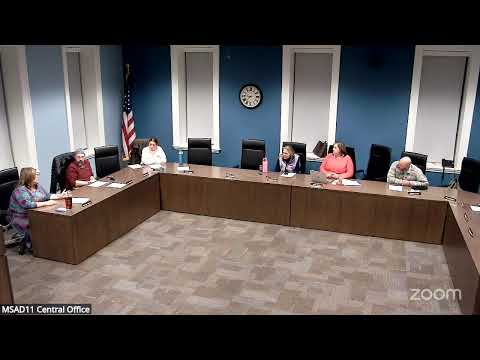
MSAD 11 finance committee dissects state EPS formula as town valuations push up local contributions
Summary
At a finance committee meeting, MSAD 11 staff laid out how the state EPS/ED279 funding model yields roughly $24.56 million in state-calculated need while the districtbudget request is $32.8 million, leaving towns to cover the gap; special-education, transportation and rising valuations were highlighted as primary drivers.
The MSAD 11 finance committee heard a detailed presentation on the stateEducation Payment System (EPS) worksheet (ED279) that underlies the districtsubsidy. Staff said the statecalculation produces roughly $24,560,000 as the districtEPS allocation, while the districtbudget passed for the current year totals $32.8 million, leaving local municipalities to cover the difference.
Why it matters: the gap between the ED279 allocation and the districtbudget translates into a significant local tax requirement. Presenters told the committee that rising state valuations — which the state uses as the basis for local share calculations — can force towns to raise more revenue even when mill expectations decline.
Committee discussion and numbers: The presenter walked through the EPS components that add to the state"bucket," including targeted funds for assessments and technology, K–2 weights and a disadvantaged weight. Special-education funding drew repeated attention: the state uses a fixed 15% prevalence benchmark in its formula, producing roughly $11,000 per special-education student under that benchmark and about $3,000 per student for counts above it, the presenter said. The presenter questioned the origin and timeliness of the 15% prevalence rate.
Transportation and out-of-district costs also loom large. The committee was told that transportation funding compares multiple formulas and typically awards the lesser result; certain special-education transportation and individualized routes can be very expensive, and staff cited an example of transportation costs approaching $70,000 for a single highly individualized placement.
Valuation effects and local shares: Using the ED279 calculation and the statevaluation approach, staff gave town-specific local-impact examples: Gardener would be required to raise about $302,000 more, Pittston about $127,990, Randolph about $40,816, and Westgardner about $198,245 under the new valuation scenario presented to the committee. The presenter said the districtadministration will produce a 10-year comparative overview and the valuation history for towns to make the timing and scale of these impacts transparent to taxpayers.
MaineCare "seed" payments and budget pressure: Staff explained that Districts receive quarterly MaineCare billing adjustments for services provided to MaineCare-eligible students; those payments reduce the districtsubsidy and have risen from about $40,000 per quarter historically to roughly $65,000–$70,000 per quarter, increasing budgetary pressure.
Whathappens next: The administration said it will finish the FY27 budget draft and present it to the committee in early March. Weekly finance committee meetings are expected through March and April with a required adoption timeline in mid-April. The presenter urged that hard budget choices will be necessary if revenue or subsidy trends continue.
Quotes: "This is what the state says that our district needs based on our students to be equitable to other students," the presenter said when summarizing the ED279 total. On special education, the presenter said: "If you ask them where they get that [15% prevalence], they can't even tell you." On MaineCare seed payments, staff said: "It used to be about $40,000 a quarter ... now it's increasing to about $65 or $70,000."
Context and limitations: The article reports numbers and descriptions given by district staff at the finance committee meeting; where the underlying state formulas and prevalence benchmarks were questioned by presenters, the committee asked for documentation. The meeting transcript does not record a roll-call vote on budget items at this session.
Next steps: Administrative staff will circulate supporting materials (ED279 pages, valuation history, 10-year budget overview) and prepare the draft FY27 budget for the finance committee in March.