Get Full Government Meeting Transcripts, Videos, & Alerts Forever!
Get email alerts on the Probation Budget topic
No spam. Unsubscribe anytime.
Board approves Santa Cruz County Probation budget amid questions over pre‑trial funding
Summary
The Board of Supervisors unanimously approved the Probation Department’s FY 2026‑27 budget after a presentation by Assistant Chief Valerie Thompson that outlined a $35 million plan and warned of expiring grants and staffing reductions; supervisors pressed staff on rising juvenile serious‑offense trends and pre‑trial program funding.
The Board of Supervisors on June 11 unanimously approved the Santa Cruz County Probation Department’s FY 2026‑27 budget after a presentation highlighting program cuts tied to expiring grants and a modest general‑fund increase.
Assistant Chief Valerie Thompson presented a $35 million plan that the department described as “the toughest” budget season in her 12½ years. Thompson told the board the department is absorbing three deleted positions, relying on one‑time restricted funds to avoid layoffs and planning revenue strategies including enhanced‑care‑management and greater Medi‑Cal (MA) claiming. She said the department’s pre‑trial unit managed an average daily population surge in 2025 but maintained an 83% court‑appearance rate and an 87% public‑safety metric.
Thompson outlined a steady stream of juvenile programs—secure youth treatment, ranch camp and a new Aztecs clubhouse—while warning of statewide trends: juvenile average daily population ticked upward from 8 to an average of 11 through May 2026. “We are seeing more serious felony charges,” she said, listing “felonious assaults, use of weapons, robberies, attempted murders.”
Supervisors pressed staff for details. Supervisor Cummings asked which offenses were driving the increase; Thompson reiterated the rise in serious felonies and emphasized the department’s focus on alternatives to detention and diversion programming. Supervisor Koig asked whether the budget relies on reserves; Thompson and CEO staff said roughly $3.6 million of restricted departmental funds will be used in FY 2026‑27 and that the general‑fund contribution rises by roughly $500,000.
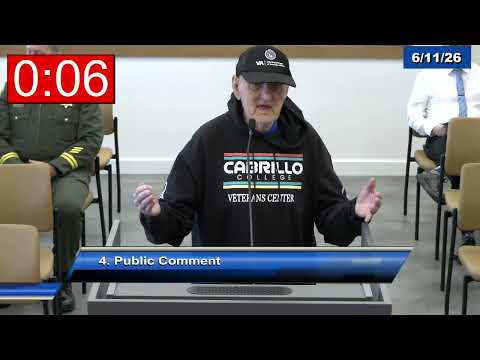
Public commenters urged continued investment in probation‑run success centers and re‑entry services and several nonprofit partners offered public support for the department’s community partnerships.
After discussion, Supervisor Hernandez moved to approve the budget, a motion seconded by Supervisor Koig; the clerk recorded a 5–0 vote to adopt the probation budget. The department will return with any adjustments if state or federal funding signals change.
The board’s action leaves probation planning to pursue the revenue options Thompson described while maintaining core re‑entry and juvenile programs in the coming year.