Get Full Government Meeting Transcripts, Videos, & Alerts Forever!
Get email alerts on the Wildfire Response topic
No spam. Unsubscribe anytime.
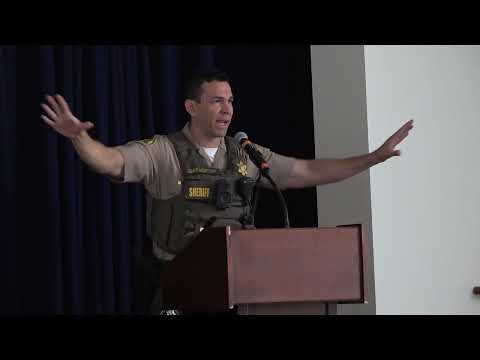
Deputy outlines LASD's role in wildfire evacuations and traffic control for Rancho Palos Verdes City
Summary
Deputy Derek Clawworthy of the Los Angeles County Sheriff's Department's Lomita station described how deputies support wildfire response, the department's under-seven-minute emergent-response target (average about four minutes), mutual-aid mobilization and specific evacuation tactics, and urged resident preparedness.
Deputy Derek Clawworthy, a community relations deputy with the Los Angeles County Sheriff's Department's Lomita Station, told Rancho Palos Verdes City residents that deputies often arrive first at fire and emergency scenes and play a supporting role to firefighters during evacuations.
"We're not firefighters, but on occasion you may have seen a deputy pick up a hose and start battling a fire," Clawworthy said, describing how deputies assess scenes, establish communications with fire partners and take steps to protect people and property.
Clawworthy outlined how calls are prioritized and how the department organizes response. He said emergent calls are targeted to be handled in under seven minutes in the jurisdiction and that the department's average response time for those calls is about four minutes. He added that if an incident exceeds local capacity, the department's mutual-aid system and its emergency operations bureau can be activated to request countywide assistance.
To illustrate scale, Clawworthy said that during recent large fires the department activated roughly 4,000 deputies over a few hours and that, when fully staffed, the Los Angeles County Sheriff's Department has about 8,500 sworn personnel.
On evacuation operations, Clawworthy described concrete tactics deputies would use in coordination with fire partners: establishing and staffing strategic posts along anticipated exit routes, directing mutual-aid officers to act as traffic controllers, conducting door-to-door checks for vulnerable residents, and setting up a public-information booth. He also said personnel can manually change traffic signals at intersections to flashing red to help manage flow.
The deputy named Genesis Protect as the evacuation-mapping software partners use to model fire spread and inform real-time decisions on whether to issue watch, warning, shelter-in-place or evacuation directives. He said the software, combined with weather and wind data, helps partners estimate where fire may move and when to evacuate particular areas.
Clawworthy emphasized community cooperation: he urged residents to enable emergency notifications, have a personal evacuation plan and a go bag, and plan ahead for pets and large animals. "If we can control that effectively and we have the buy-in and discipline of our community, we are much less likely to experience a bottleneck situation," he said.
In a closing anecdote, Clawworthy described a past landslide response where deputies remained to facilitate evacuation, mutual-aid partners provided tools such as drones, and the department later detained people attempting to burglarize evacuated properties. He closed by inviting residents to visit the sheriff's booth outside the meeting for questions.
The department presented tactics and preparedness guidance; there was no motion or formal action recorded during the presentation. The meeting proceeded to audience questions after Clawworthy's remarks.