Get Full Government Meeting Transcripts, Videos, & Alerts Forever!
Get email alerts on the Utility Rates topic
No spam. Unsubscribe anytime.
Centerton council adopts emergency one-year water and sewer rate increases to take effect Jan. 1, 2026
Summary
Centerton City Council unanimously approved two emergency ordinances Dec. 15 that raise sewer base rates and pass through higher water costs for 2026, citing a rate study, state requirements and the need to protect the utilities’ financial integrity. Officials said the average household impact is under $5; a follow-up rate study is planned for 2026.
The Centerton City Council voted unanimously Dec. 15 to adopt two emergency ordinances that raise city sewer and water rates for 2026 and make the changes effective Jan. 1, 2026.
Council members adopted ordinance 2025-67, which adjusts sewer service rates and includes an emergency clause the council said was needed "to ensure the financial integrity of the operation of the sewer system," and ordinance 2025-68, which adjusts municipal water rates and similarly takes effect Jan. 1, 2026. Both measures passed on unanimous roll-call votes recorded as yes by Cliff Thompson, Justin Calgary, Wendy Henson, Jesse Reid, Joshua Hagen and Cody Miles.
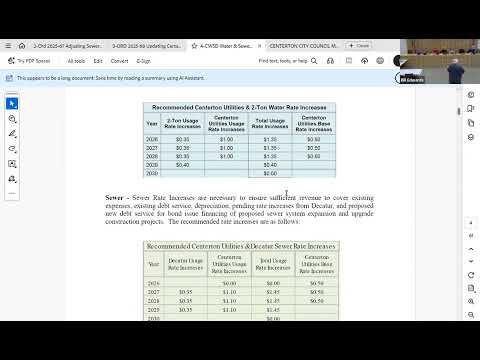
The council described the 2026 changes as a one-year, incremental step while staff and the commission continue work on a longer-term rate plan. Officials said the water-pass-through recommendation includes a 35-cent increase tied to wholesale costs plus an additional 10 cents intended to cover administrative costs; the sewer proposal includes a 50-cent increase to the base rate and a 35-cent pass-through tied to wholesale charges. Council members and staff said those combined increases translate to an average household increase of less than $5 per bill, though an exact per-customer dollar figure was not specified in the meeting.
"The main reason for the emergency clause on both of them is just to make sure we ensure the financial integrity operation of the sewer system," the meeting chair said, explaining why the council moved to make the ordinances effective Jan. 1 rather than after the usual 30-day period.
Council members and a staff speaker described the broader context: a recently completed rate study projects multi-year needs but the commission and council preferred an incremental one-year action given uncertainty in construction costs and regionalization decisions. The council said it expects to commission another rate study in 2026, estimated in the meeting at roughly $6,000–$7,000 for professional services, to reassess longer-term needs and the scope of future increases.
A resident who spoke during the added public-comment portion asked whether the increases would fund upgrades to aging lines on particular corridors; council and staff replied that some upsizing projects will be financed from reserves, that the rate study projections include anticipated construction needs, and that the 2026 adjustment is intended as a near-term step while additional planning and financing are completed.
The ordinances cite compliance with municipal code amendments and cite state-level requirements that have prompted utilities to perform and, where required, implement rate studies to avoid fiscal distress. Council members said the increases are intended to cover higher treatment costs, anticipated construction and maintenance, and the city’s growth.
The council adjourned after adopting the ordinances. Officials said they will return with a follow-up rate study and further analysis during 2026; no further votes on these ordinances were scheduled at the meeting.