Get Full Government Meeting Transcripts, Videos, & Alerts Forever!
Get email alerts on the Literature Event topic
No spam. Unsubscribe anytime.
Geraldine Brooks, winner of the Library of Congress fiction prize, reflects on reporting, research and grief
Summary
At a Library of Congress event, novelist Geraldine Brooks discussed her transition from foreign correspondent to historical novelist, the research behind books such as "Horse" and "March," and writing her nonfiction Memorial Days to process personal loss; Ron Charles moderated a wide-ranging Q&A.
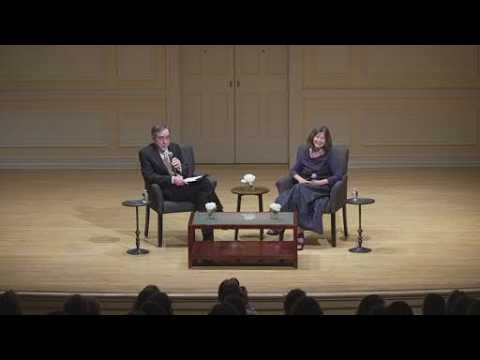
Geraldine Brooks, the 2025 winner of the Library of Congress Prize for American Fiction, spoke at the Library of Congress about how her career as a foreign correspondent shaped her research-driven novels and why she turned to nonfiction to process personal grief.
Robin Dale, deputy librarian for Library Collections and Services, opened the evening and noted that acting Librarian Robert Newland appointed Brooks as this year’s prize recipient. Ron Charles, a longtime critic for The Washington Post who now writes on Substack, moderated the conversation and asked Brooks about influences ranging from American literature to her work as a journalist.
Brooks described how reporting in conflict zones taught her that “you often know more than you can prove,” and how fiction lets her “follow the line of fact as far as it leads.” She recounted a reporting assignment in Nigeria that investigated allegations that Shell Oil worked with the military against local communities; Brooks said she collected evidence, sought comment from the military, was detained briefly and ultimately deported while pursuing the story.
Her journalism background, she said, feeds her novels’ emphasis on archival research and recovered voices. “When the historical voices fall silent… you can do all that research, and you can figure out what you think might have happened, and you can just write it,” Brooks said, explaining why she writes historical fiction.
On the subject of race and historical memory, Brooks reflected on Reconstruction and contemporary retrenchments in civil-rights progress. She criticized what she described as the firing of Dr. Carla Hayden and framed those personnel changes as part of a broader, worrying trend affecting public institutions and career public servants.
Asked why two young Black protagonists in her novel Horse do not both end with hopeful outcomes, Brooks said she aimed for truthfulness to the historical record and the emotional logic of the story: “If one swam, I felt like the other one had to sink because if they both swam, it would be untrue to the history of race.”
Brooks also described writing Memorial Days, her recent nonfiction book, as a project she undertook to process the death of her husband, Tony Horwitz. “I needed to write it,” she said; she added that the book has produced an unusually large volume of correspondence from readers about loss and grief.
The conversation turned to the future of journalism. Charles said newsrooms are shrinking at a moment when journalism is most needed; he and Brooks discussed emerging nonprofit, cooperative and subscription models that aim to sustain investigative work outside traditional ad-driven structures.
On craft, Brooks said she works instinctively rather than from outlines, often writing in short stretches of time while balancing family responsibilities. She quoted a sculptor friend’s description of the creative process: “mess, mess, mess, art.”
The event concluded with audience questions and an announced book signing after the program. Brooks named recent literary influences—including Richard Powers and Marilynne Robinson—and said she is working on a new historical novel while in residence at New College, Oxford.