Get Full Government Meeting Transcripts, Videos, & Alerts Forever!
Get email alerts on the Artist Talk topic
No spam. Unsubscribe anytime.
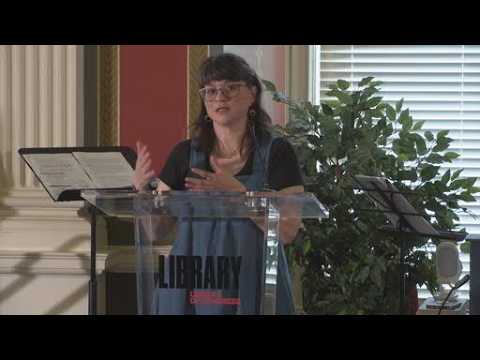
Artist Jessica C. White traces book history and converts a 20-foot scroll into a 'crankie' performance
Summary
Jessica C. White, an artist and educator, traced scrolls-to-books history across regions and described transforming a 20-foot thesis scroll into a performance 'crankie'; she answered audience questions about cataloging and historical examples (date not specified).
Jessica C. White, an artist and educator invited to the Library of Congress symposium Our Common Ground, used her talk to trace how materials and formats shaped reading practices from Sumerian clay tablets to papyrus, bamboo slips and Chinese scrolls. “I actually studied sculpture,” she said, and described training in paper conservation and an MFA in printmaking that shaped her interest in historic book structures.
White showed how different materials produce different formats — palm leaves and bamboo slips produced columnar and scroll structures, papyrus lent itself to rolling, and the invention of paper around 100–105 CE enabled folded and sewn gatherings that made indexical reading possible. She cited the Nag Hammadi codices and Coptic sewing as formative developments and noted that very few Mesoamerican manuscripts survive (she said about 12 remain).
Turning to contemporary practice, White described her own letterpress and wood-engraving work and recounted converting a 20-foot scroll from her thesis into a crankie — a boxed moving-scroll performance format — which she has since performed at Crankie Fest. On terminology, when Jackie, a Rare Book Cataloger at the Library, asked whether 'crankie' should be a catalog term, White replied that the term is widely used by makers and that spelling varies; she spells it with an I-E.
In a brief Q&A, White answered audience questions about editions (she said a single small accordion would not hold a long text like The Art of War in its entirety), selecting stories (she often transforms songs or vivid narratives), and whether older crankies survive in museum collections (some do; she named the New Bedford Whaling Museum as one example).
White invited attendees to a crankie performance later in the program and encouraged researchers to look for fragile traveling examples that may survive in private hands.