Get Full Government Meeting Transcripts, Videos, & Alerts Forever!
Get email alerts on the Event Coverage topic
No spam. Unsubscribe anytime.
Library of Congress opens 'Our Common Ground' symposium showcasing book arts and nature
Summary
The Rare Book and Special Collections Division opened Our Common Ground, featuring prints, artist books and public programming that explore 250 years of Americans engaging with nature, plus K–12 resources and a live crankie performance (date not specified).
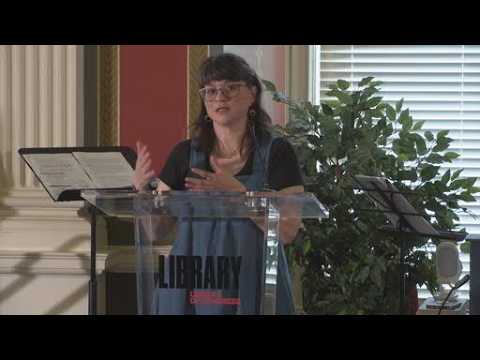
Stephanie Stillo, chief in the Library of Congress’s Rare Book Division, opened Our Common Ground: 250 Years of Americans Engaging with Nature with remarks thanking staff, volunteers and supporters and framing the symposium around community and gratitude. “My name is Stephanie Stillo, and I am the proud Chief of a truly amazing group of curators and librarians in the Rare Book Division,” she said, and invoked artist Josef Albers’s idea that certain combinations can make colors “elevate one another” as a metaphor for collaborative scholarship.
Dr. Ashley Rose Young, who helped organize the program, described how the symposium grew from a 2024 idea by outreach specialist Patrick Hastings into a multi-part event that pairs talks with a vault exhibition and a series of educational videos and classroom packets for K–12 teachers. Young asked attendees to view examples next door and highlighted featured items drawn from the Rare Book Division’s holdings and recent acquisitions.
Items on display include contemporary and historical book arts and wood engravings by Tom Killian, Richard Wagner, Barry Moser and Gaylord Schanilec; Clare Leighton’s 1942 Southern Harvest; Cecilia Vicuna’s Chicana Quipu; Anne Cavell’s History of a Felling; and a Milton Bradley panorama titled The Historiscope. Young noted the program’s public-facing outputs — videos and a blog series — and thanked the Friends of the Library and the James Madison Council for financial and institutional support.
Organizers stressed that the program is both scholarly and public-facing: it pairs close study of historic structures and conservation with demonstrations and a later-stage crankie performance that translates a 20-foot scroll into a performative format. Attendees were invited to tour the display, watch the video series posted by the Rare Book Division, and attend the scheduled crankie performance later in the day.