Get Full Government Meeting Transcripts, Videos, & Alerts Forever!
Get email alerts on the Behavioral Health Block Grants topic
No spam. Unsubscribe anytime.
Committee reviews and approves Kentucky's year-27 mental health and substance use block grant plan
Summary
Officials from the Department for Behavioral Health, Developmental and Intellectual Disabilities briefed the committee on the year-27 abbreviated unified block grant application, including program requirements, set-asides and recent outcome figures; the committee approved the plan by voice vote.
Melissa Renan, block grant program administrator for the Department for Behavioral Health, Developmental and Intellectual Disabilities, and Patty Clark, director of the Division of Mental Health, presented Kentucky's abbreviated (year-27) unified block grant application, which covers the Mental Health Block Grant (MHBG) and the Substance Use Prevention, Treatment, and Recovery Services block grant.
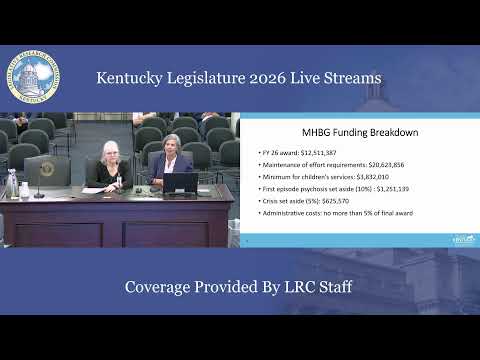
Renan explained the MHBG requirements and set-asides: a 10% set-aside for first-episode psychosis programming, a 5% set-aside for crisis services and a mandated children's services minimum. She said the planning amount to use for budget calculations for this mini application is the "12 million number" referenced during the briefing and described maintenance-of-effort and a 5% cap on administrative costs.
Clark outlined substance-use grant priorities and the 20% primary prevention requirement, plus a statutory minimum (the presentation referenced "2.6 million" as the pregnant-women/women-with-dependent-children set-aside amount for planning). Clark described school-based prevention programs (eg, Too Good For Drugs, Sources of Strength) and community education that the primary prevention funds will support.
Panelists summarized recent outcomes from state fiscal year 25: unduplicated counts of people served (about 43,000 adults with serious mental illness; 19,649 children with serious emotional disturbance), more than 225,000 crisis call-center responses (including nearly 39,000 988 calls), and reporting on first-episode psychosis programming (282 young people served with favorable short-term arrest and hospitalization outcomes while in treatment). For substance-use services, presenters cited 15,374 unduplicated people served and noted prevention activities were tracked as duplicated activity counts (about 20,959 activities recorded); presenters also reported a 30.2% reduction in overdose deaths (presented as a summary figure).
After questions from committee members (including clarification on primary prevention programs and administrative spending), the committee took a motion and a voice vote to approve the abbreviated year-27 plan. The motion passed with an affirmative voice vote and no recorded opposition.
The committee adjourned after the vote; presenters said they would continue required public posting, public comment steps and reporting to the federal grant programs.