Get Full Government Meeting Transcripts, Videos, & Alerts Forever!
Get email alerts on the Accreditation topic
No spam. Unsubscribe anytime.
Principal Dr. Butler outlines path to 2028 NEASC reaccreditation for Bangor High School
Summary
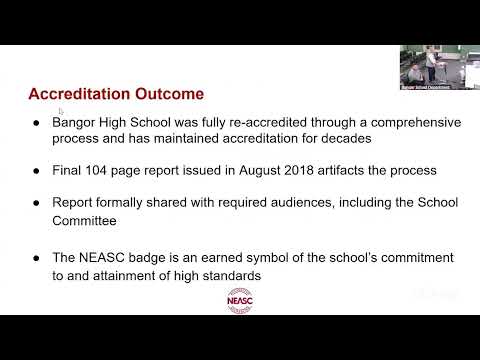
Principal Dr. Butler told the school committee the NEASC reaccreditation process is a decade-long, committee-driven self-study and highlighted strengths such as expanded dual-enrollment, CTE pathways and recommended work on cross-curricular rubrics; follow-up reports are required at years five and seven.
Principal Dr. Butler presented a detailed update on Bangor High School’s accreditation status and preparations for a 2028 reaccreditation by the New England Association of Schools and Colleges (NEASC).
Dr. Butler said the NEASC process requires a comprehensive, committee-driven self-study and periodic follow-up: "It's a 10-year process. We are past the seven-year mark," he told the committee, describing multi-year preparation, a deep self-study and a four-day site review format.
Why it matters: accreditation is the regional external check on teaching, learning, leadership and resources. Dr. Butler summarized the 2018 review as broadly positive and said the report identified strengths (shared core values, broad access to rigorous courses, increased dual-enrollment and strong CTE/academy programs) and recommended improvements (greater consistency in curriculum documentation and cross-curricular rubrics).
Dr. Butler noted growth in advanced academic opportunities: the number of in-house dual-enrollment courses at the high school has "quadrupled," and CTE pathways and academy programs have expanded. He described accreditation recommendations as a roadmap that districts address through five- and seven-year progress reports submitted to NEASC.
Committee members asked how the findings will inform district planning. Member Luciano asked whether the recommendations would feed into strategic planning; Dr. Butler and Superintendent Robinson encouraged integrating NEASC findings with the district’s strategic work. Member Cook suggested regional partnerships to share expertise on rubrics and documentation; Dr. Butler said the district is open to collaborating with neighboring schools and regional organizations.
What’s next: Dr. Butler recommended convening school and cross-department committees later this school year or next to launch the self-study, recruit staff to serve on visiting teams, and begin portal reporting and evidence collection ahead of the 2028 site visit.