Get Full Government Meeting Transcripts, Videos, & Alerts Forever!
Get email alerts on the Utility Infrastructure topic
No spam. Unsubscribe anytime.
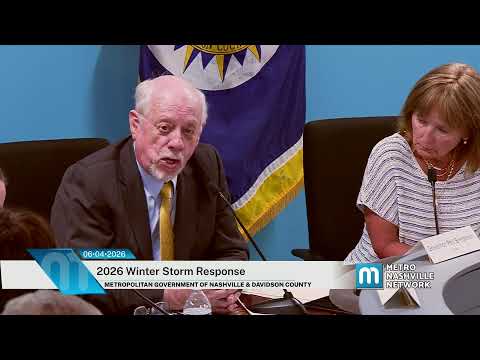
NES tells Metro commissioners it has tightened storm response after Winter Storm Fern; estimates roughly $105 million in costs
Summary
Nashville Electric Service told a Metro commission it has adopted a four‑pillar reform plan after Winter Storm Fern, including new emergency‑management staffing, upgraded communications, an estimated‑time‑of‑restoration framework and vegetation and undergrounding efforts; NES said storm costs are about $105 million and it expects FEMA reimbursement.
Nashville Electric Service’s president and CEO, Teresa Broyal Zapplan, told a Metro commission meeting that NES has moved quickly to adopt operational changes after Winter Storm Fern, calling the event “an unprecedented natural disaster” and laying out a four‑pillar response program of emergency management, communications, estimated time of restoration (ETR) and system resiliency.
"With Winter Storm Fern — a storm of this magnitude which we've never faced before — there were a lot of takeaways for us," Zapplan said, summarizing the utility's immediate and near‑term actions. She said NES had aligned its incident command structure with NIMS and the American Public Power Association, deployed an interim emergency response plan (operational May 21) and hired an emergency‑management professional to accelerate training and scalable incident response.
Why it matters: Commissioners pressed NES on where it had fallen short and what it will change. The utility agreed the scale of the storm exposed gaps in communications, mutual‑aid planning and some aspects of operational command, and described steps to reduce repeat failures — including more in‑house communications staffing, new storm contracts for linemen and data tools intended to make restoration timetables more consistent and reliable.
Communications and customer messaging: NES said it had materially upgraded several customer‑facing systems — load‑testing a high‑volume call platform to handle up to 1,000 concurrent callers (previously ~300), scaling IVR and text platforms, and improving the outage map in three rounds. Zapplan said NES will recruit a chief communications officer and shift more communications work in‑house to be embedded in operations teams.
Alicia Johnson, NES interim vice president for customer service, told commissioners that live agents answered calls 24/7 during the storm and that automated “restored” text messages were suspended while NES corrects AMI (metering) blind spots that caused customers to receive premature restore notices. "We have suspended reconnect text messages," NES said, to avoid sending inaccurate restoration updates while the network is upgraded.
Estimated time of restoration and data tools: NES described an ETR framework based on 308 historical storm events and an early‑stage ETR calculation that uses inputs such as crew counts and equipment availability. Zapplan said NES has contracted fixed‑wing aerial assessments and is working on a digital‑twin project with Oak Ridge National Laboratory to improve damage prediction and faster, more accurate ETRs.
Resiliency, pilots and tree trimming: NES said it had selected a vendor for a system‑level undergrounding study, budgeted four small pilot undergrounding projects and completed a 10‑year reliability plan. To reduce vegetation‑caused outages, NES described moving from a four‑year trim cycle toward a three‑year cycle and adopting a wider clearance (moving toward a 15‑foot clearance standard with no overhang in higher‑risk areas). NES estimated trimming costs at about $25,000 per mile in the upcoming year and said pilots will focus on difficult back‑lot routes and low‑performing circuits.
Mutual aid, crew counts and supplies: NES officials said the company mobilized far more field resources than in prior storms. Leadership described staged mutual‑aid waves — one early commitment of roughly 335 line workers and later additional waves — and multiple references in the briefing placed total storm‑period crews in the many‑hundreds to low‑thousands range (speakers used figures ranging from roughly 1,500 to ~1,900 workers at peak mobilization). NES said it began the event with roughly 3,500 poles in stock and rapidly purchased more materials during restoration; it is considering dedicated storm stockpiles for long‑lead items.
Command, EOC and coordination: NES described activating an internal EOC (storm number created; EOC active beginning Feb. 23 at 6 p.m.), twice‑daily update meetings and 16‑hour operational shifts to manage response. NES acknowledged the need for clearer single‑person incident command in very large events and said it will create a larger, better‑equipped EOC with defined roles and place‑cards to streamline decision‑making. NES also described joint after‑action reviews with Metro OEM and said it will pursue tabletop and coordination exercises.
Costs and finance: On the budgetary impact, NES said early estimates in the $100–140 million range had been refined and the current working estimate is about $105 million. NES said it expects FEMA reimbursement and plans to use commercial paper and a planned bond issuance to manage interim cash needs; the utility did not anticipate a near‑term rate increase in the next fiscal year.
Critical‑care customers: NES said about 80 customers had been enrolled in its critical‑care program pre‑storm and that further outreach and cross‑checks with state data added roughly 40 more facilities; the utility now estimates about 500 customers on the critical‑care list. NES cautioned commissioners that enrollment in the list does not guarantee front‑of‑line restoration for individual addresses in a city‑wide catastrophe and encouraged customers to maintain backup plans.
Independent review and next steps: NES said the board hired PA Consulting for a 30‑day after‑action review; PA’s recommendations — a more scalable ERP, clearer ICS roles, a damage‑prediction model, ETR strategy and stronger communications — are being incorporated into NES’s immediate work plan. NES said it would return with follow‑up briefings and that the commission staff will prepare a fact‑based report for later recommendations.
Public comment: Ruby Baker, president of the Bordo Hills Residential Association, thanked INDOT for debris removal and NES for outreach and an improved outage map, and urged continued neighborhood engagement in preparedness and recovery planning.
What’s next: Commissioners asked NES to pursue more robust, transparent communications, finalize the undergrounding study, clarify the planned staffing and mutual‑aid contracts, and continue joint after‑action work with Metro OEM. The commission adjourned after directing staff to draft an independent fact report for future recommendations.
Quoted speakers in this article are drawn directly from the transcript of the session and are attributed to the speakers who made them.